v1.34.0 (August 25, 2026)
New Features
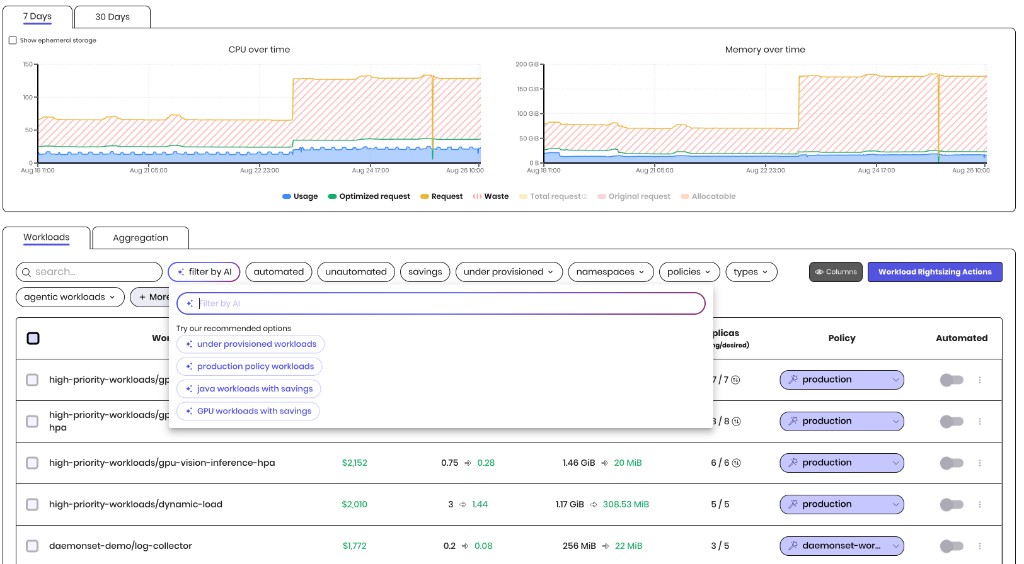
- AI Filtering: Added AI-powered filtering across product pages, letting you describe what you are looking for instead of building filter combinations manually.
Enhancements and Updates
- Java Optimization:
Learn more in the Java Optimization documentation.
- Added full Java gitops support
- Turning on Java automation now also turns on Java recommendations, so both can be enabled together
- Redesigned the Java Optimization page for a clearer, more intuitive experience and improved visibility into optimization opportunities
- Replica Optimization: Replica recommendations now account for PodDisruptionBudgets, so ScaleOps does not scale a workload so low that the PDB blocks voluntary disruptions. Learn more in the Replica Optimization documentation.
- Auto Healing - CPU Pressure: Auto Healing now also responds to CPU pressure (wait time), so workloads that stall while competing for CPU on a contended node are addressed even when their CPU usage looks healthy. Learn more in the Auto Healing documentation.
- GPU Analytics Filters: Added GPU type and instance type filters to the GPU analytics and cost comparison pages. Learn more in the GPU Optimization documentation.
- Multi-Cluster Cluster Data Download: Download cluster data now supports multi-cluster environments.
Security
- Addressed CVEs: CVE-2026-71556, CVE-2026-71557, CVE-2026-46600
v1.33.0 (July 28, 2026)
New Features
- API Keys: Added API Keys support, enabling secure programmatic access to ScaleOps for scripts, automations, and third-party integrations using dedicated API keys. Learn more in the API Keys documentation.
- AI Agent Smart Policy: Introduced an out-of-the-box smart policy tailored for AI agent workloads, which exhibit unique resource patterns such as idle periods followed by sudden compute bursts. Includes a dedicated AI Agent tab in the workload overview for visibility into agentic workload behavior.
- Agent Sandbox Custom Workload Support: Added a built-in Agent Sandbox workload grouping that automatically identifies and groups agent workloads, applying resource optimization immediately without requiring manual configuration. Learn more in the Custom Workloads documentation.
Enhancements and Updates
- Java Optimization:
- Added the ability to enable or disable Java optimization per namespace and workload, giving teams granular control over rollout. Learn more in the Java Optimization documentation.
- Exposed Java eviction event in workload timelines for better observability into JVM-related pod restarts
- Added option to retry failed injection in the UI, reducing the need to wait for a pod restart when JMX injection fails
- Replica Threshold Optimization: Added custom target latency configuration per workload, allowing teams to define their own latency targets instead of relying on defaults. Learn more in the Replica Threshold Optimization documentation.
- Cross-Namespace Grouping for Custom Workloads: Custom Owner Grouping now supports cross-namespace grouping, enabling accurate resource recommendations for workloads that share an owner across multiple namespaces. Learn more in the Custom Workloads documentation.
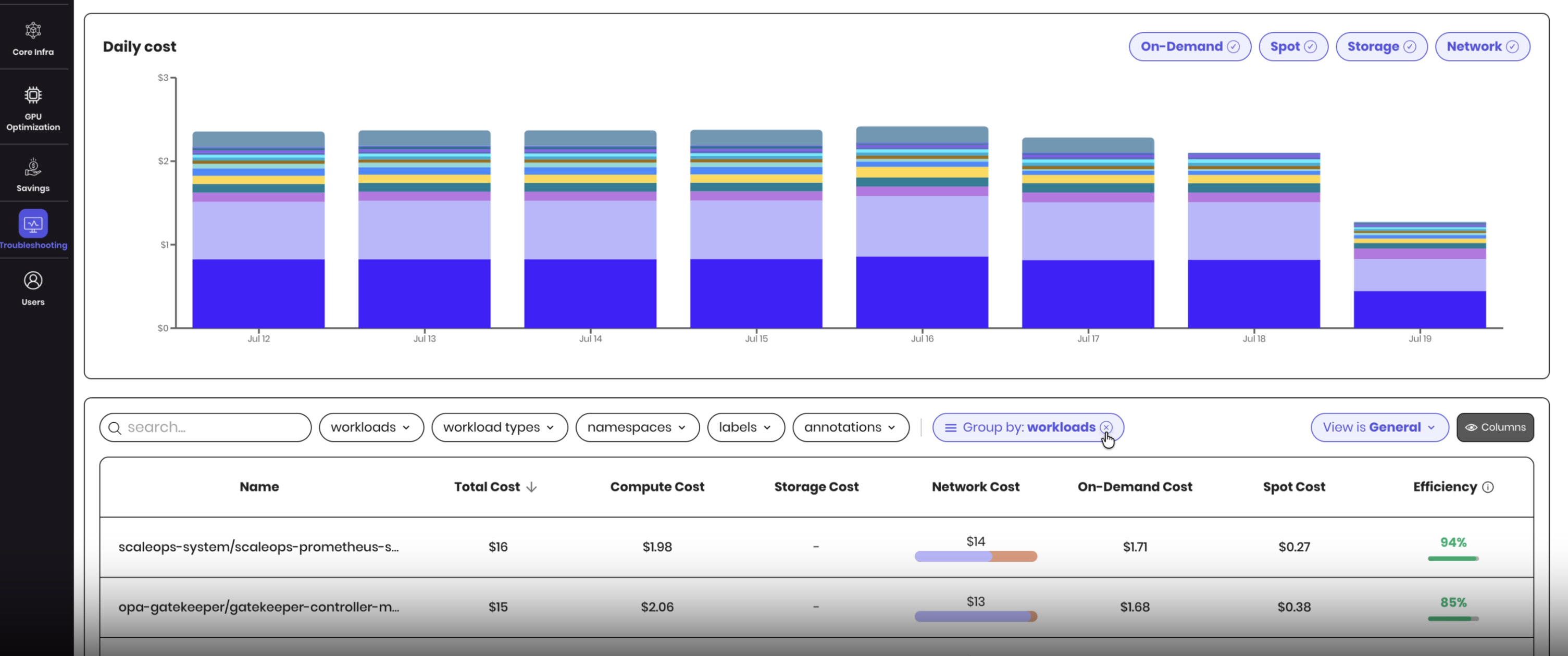
- General Cost Report: Added a new general cost report providing a consolidated view of cluster costs across workloads and namespaces. Learn more in the Cost Report documentation.
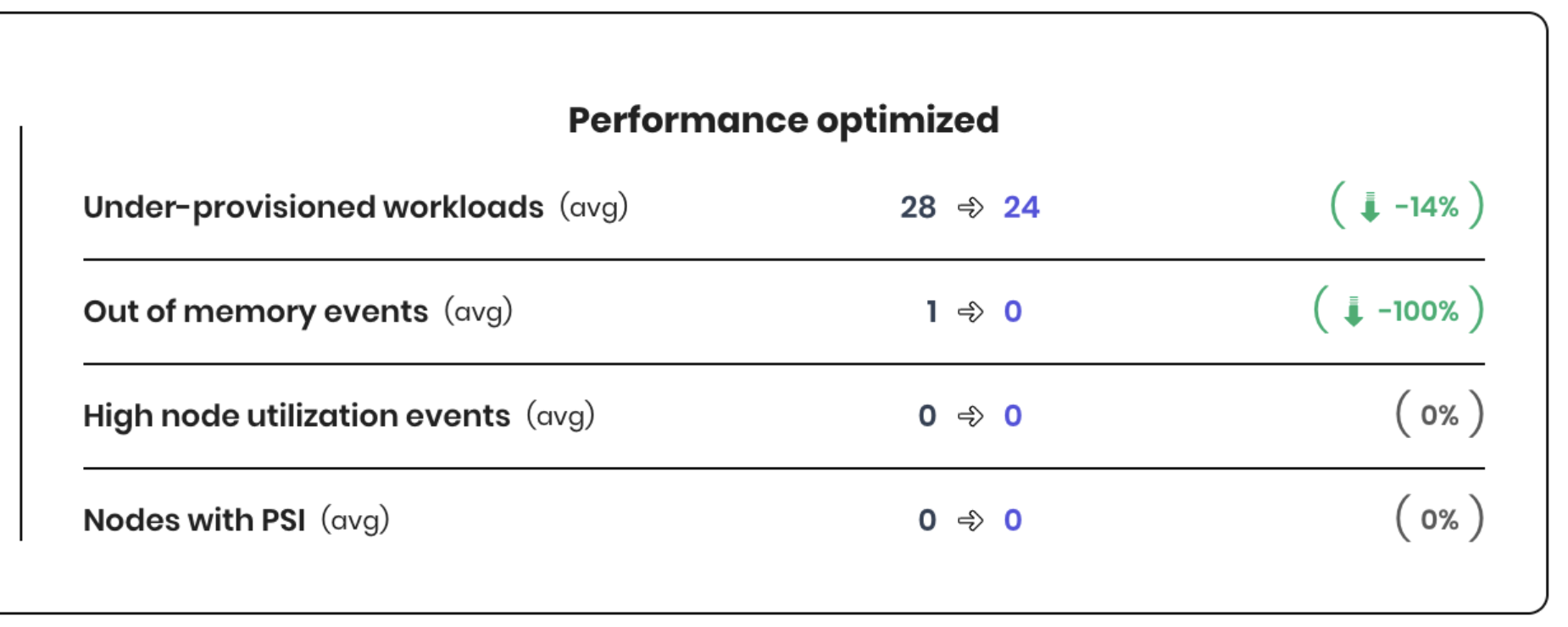
- Allocatable Comparison: Added Performance Optimized metrics for clearer visibility into how performance tuning affects resource allocation.
- Resources Analytics: Added performance metrics alongside cost metrics for a more complete view of optimization impact.
- GPU Optimization Enhancements:
- Added GPU automation via namespace annotations for GitOps workflows, enabling teams to manage GPU optimization declaratively
- Added default GPU policy to COG, ensuring GPU workloads are optimized out of the box when grouped
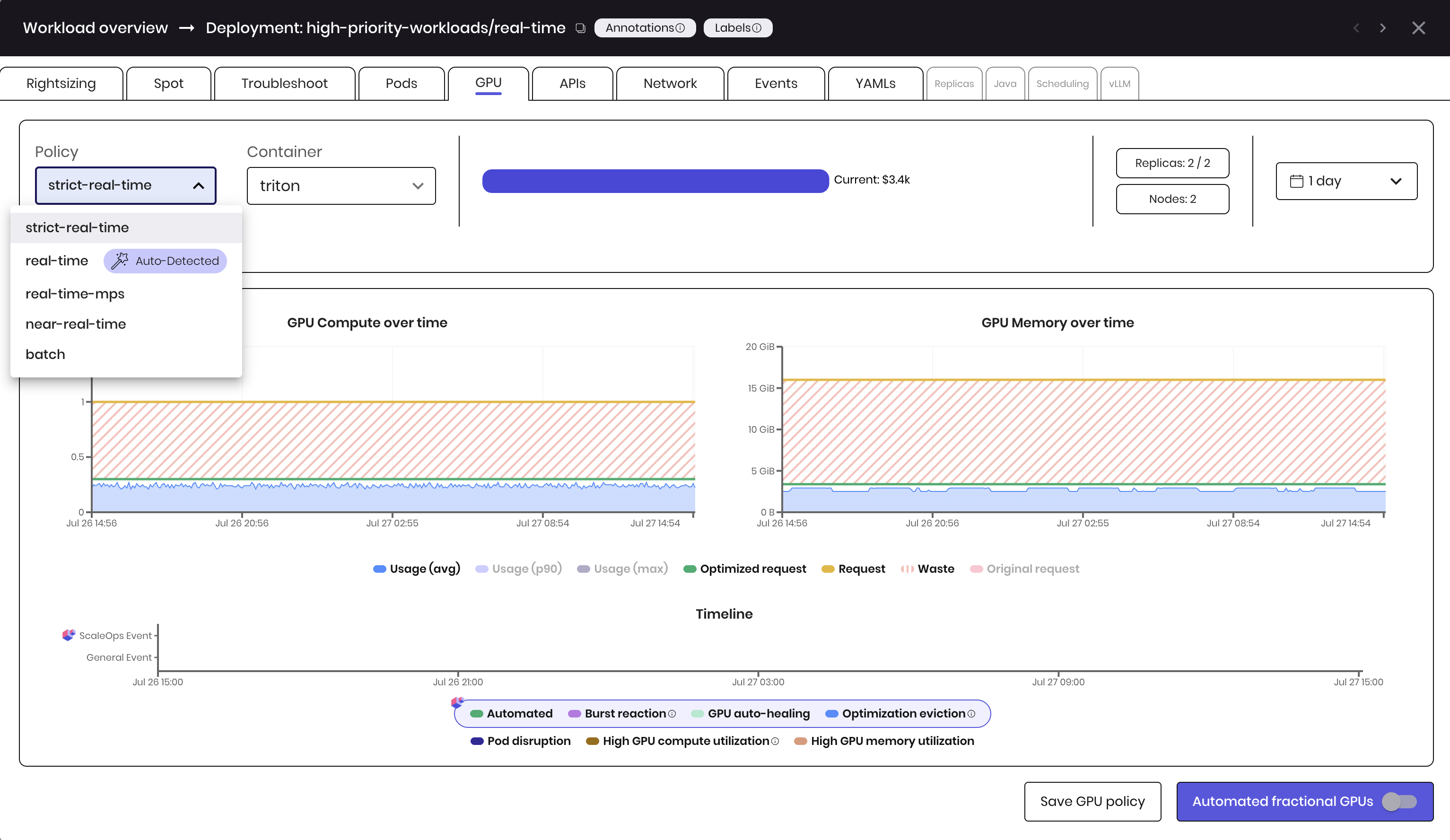
- Added strict real-time GPU policy for latency-critical inference workloads that require conservative optimization to avoid disruption. Learn more in the GPU Policies documentation.
Fixes and Improvements
- Ephemeral Storage: Improved image size handling in ephemeral storage recommendations to prevent out-of-storage events for workloads with large container images.
- Java Optimization: Fixed JMX Injector failing when
-server/-clientJVM flags are provided. - GPU Scheduling: Fixed a scheduler error causing GPU automated pods to be stuck in pending state.
- Workload Language Detection: Fixed misdetection caused by PID reuse on crash-looping pods, which could result in incorrect optimization being applied.
- SSO: Added groups filter regex support for all SSO providers, enabling consistent group filtering across identity providers.
- Node OOM Autohealing: Improved node-level Out-Of-Memory autohealing behavior and reliability.
- GPU Detection: Added automatic GPU setup detection from ClusterPolicy, removing the need for manual CDI configuration.
Security
- Addressed CVEs: CVE-2026-41579, CVE-2026-5450, CVE-2026-50151, CVE-2026-39822, CVE-2026-53572, CVE-2022-48174, CVE-2026-50163, GHSA-hrxh-6v49-42gf
v1.32.0 (June 22, 2026)
New Features
- Java Optimization is now GA: Java optimization has graduated from beta and is now generally available, providing production-grade JVM rightsizing and autohealing capabilities. Learn more in the Java Optimization documentation.
- ScaleOps AI Agent in Slack: Introduced the ScaleOps AI Agent Slack application, enabling users to interact with ScaleOps directly through Slack mentions and query cluster insights and optimization recommendations without leaving Slack. Learn more in the ScaleOps AI Agent in Slack documentation.
Enhancements and Updates
-
Observability DaemonSet Enabled by Default: The
scaleops-network-monitorDaemonSet is being gradually rolled out to be enabled by default, providing enhanced visibility into network traffic, API performance, and workload behavior across your cluster. This powers key capabilities including API observability, network monitoring, and workload identification — and is required for features such as Threshold Optimization. Learn more in the Network Observability documentation. -
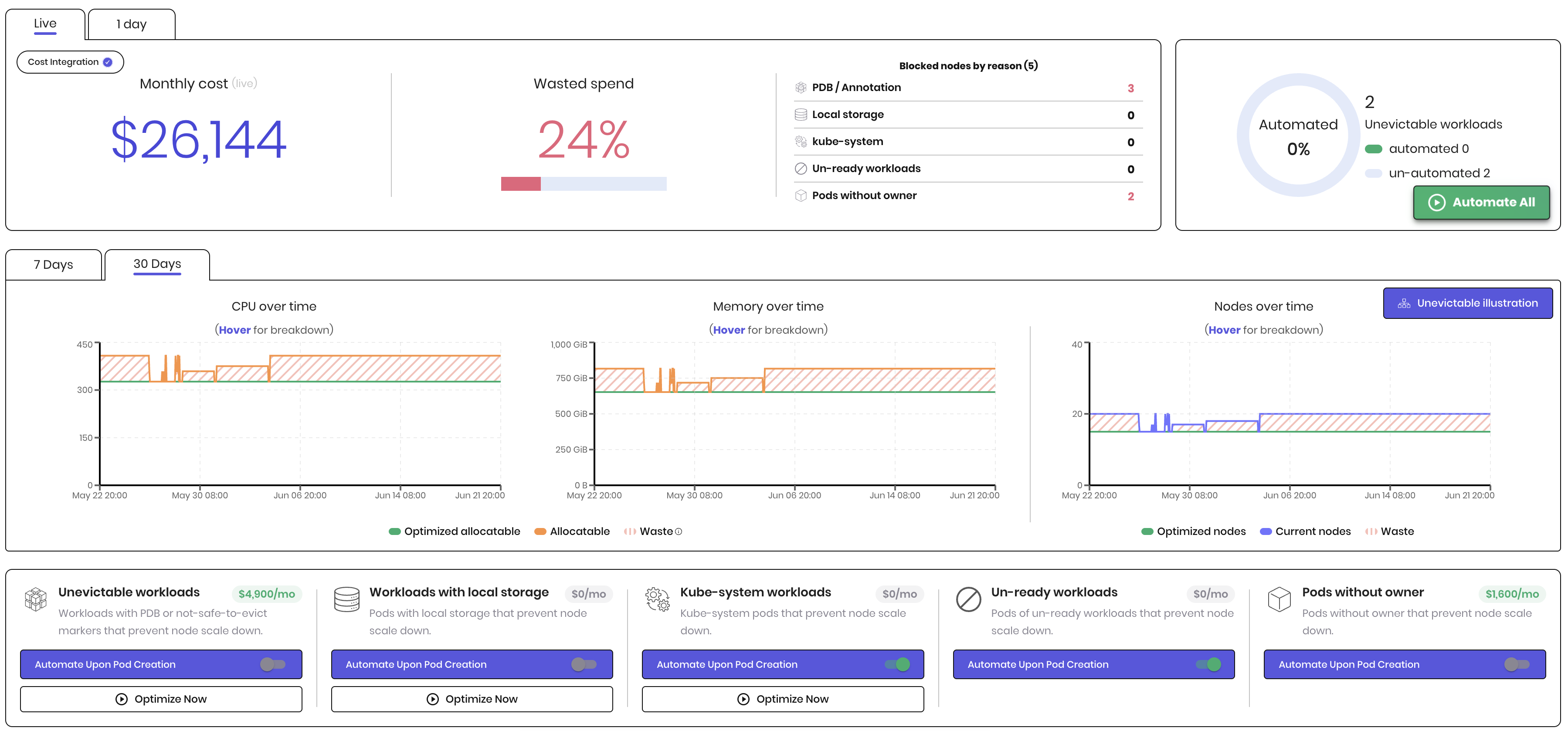
Pod Placement - New Layout: Updated the Unevictable page under Pod Placement, simplifying management and automation control.
-
GPU Policy - Custom Policy Rules: Added support for custom policy rules for GPU policies, enabling finer control over GPU optimization behavior. Learn more in the GPU Policy Rules documentation.
-
Resource Over Time - Live Data Point: Added a live data point to the Resource Over Time graph for real-time visibility into current resource usage.
-
Workload Overview - Source of Automation Badge: Added a source of automation badge to the Workload Overview, making it easier to identify how automation is being applied to each workload.

-
Analytics - Performance Optimized Workloads: Added ‘Performance Optimized’ workload and pod counts to the Analytics page for clearer visibility into performance-focused optimization coverage.
Fixes and Improvements
- Troubleshooting - Downtime Events Graph: Fixed missing events in the troubleshooting Downtime Events graph.
- JMX Injector: Improved reliability of JMX injector on JBoss EAP and JBoss Modules with Java 17+.
Security
- Addressed CVEs: CVE-2026-39830, CVE-2026-39821, CVE-2026-2303
v1.31.0 (June 8, 2026)
New Features
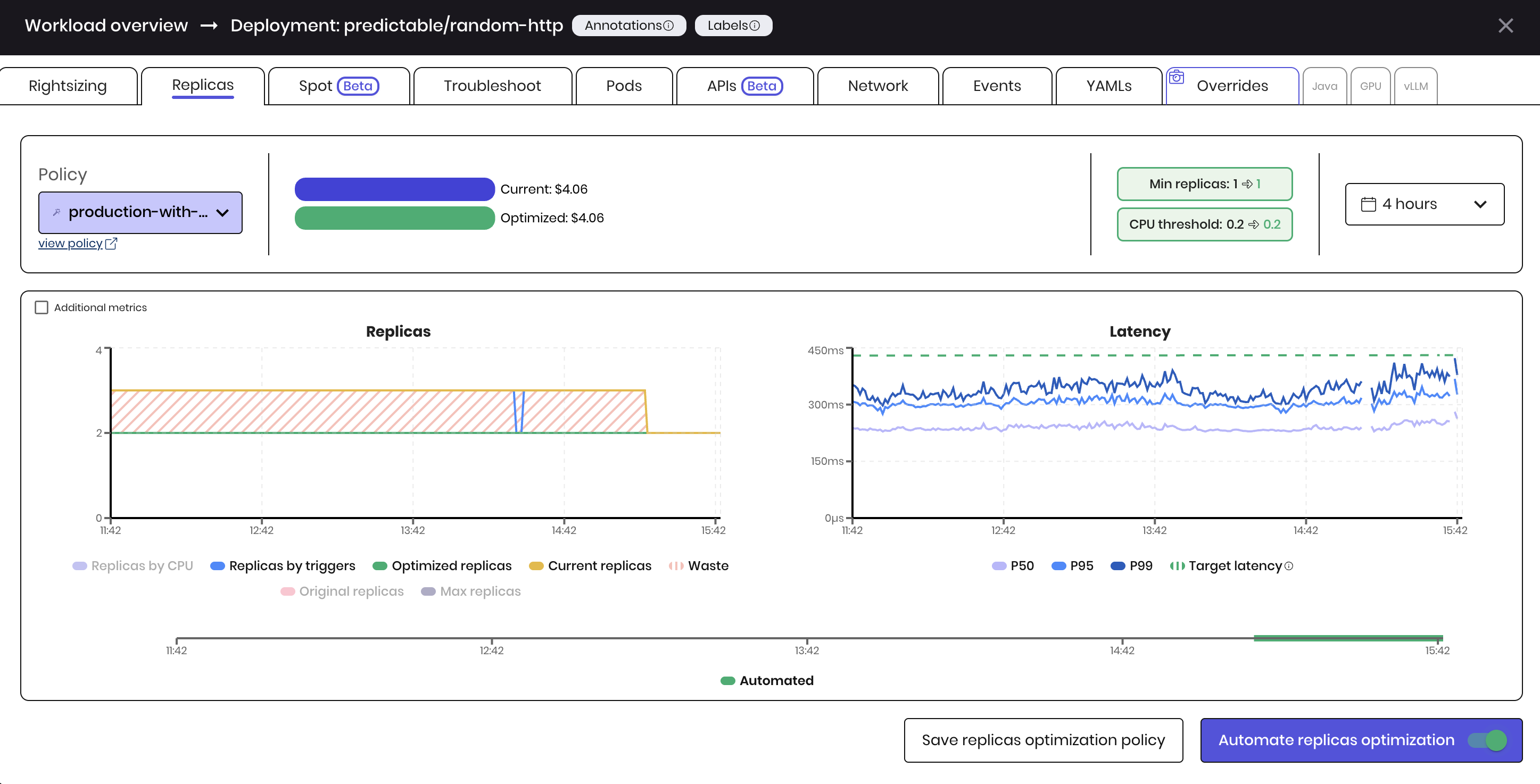
- Replica Threshold Optimization: Introduced automated replica threshold optimization that reduces the number of replicas while maintaining workload latency, maximizing cost savings without sacrificing performance. Learn more in the Replica Threshold Optimization documentation.
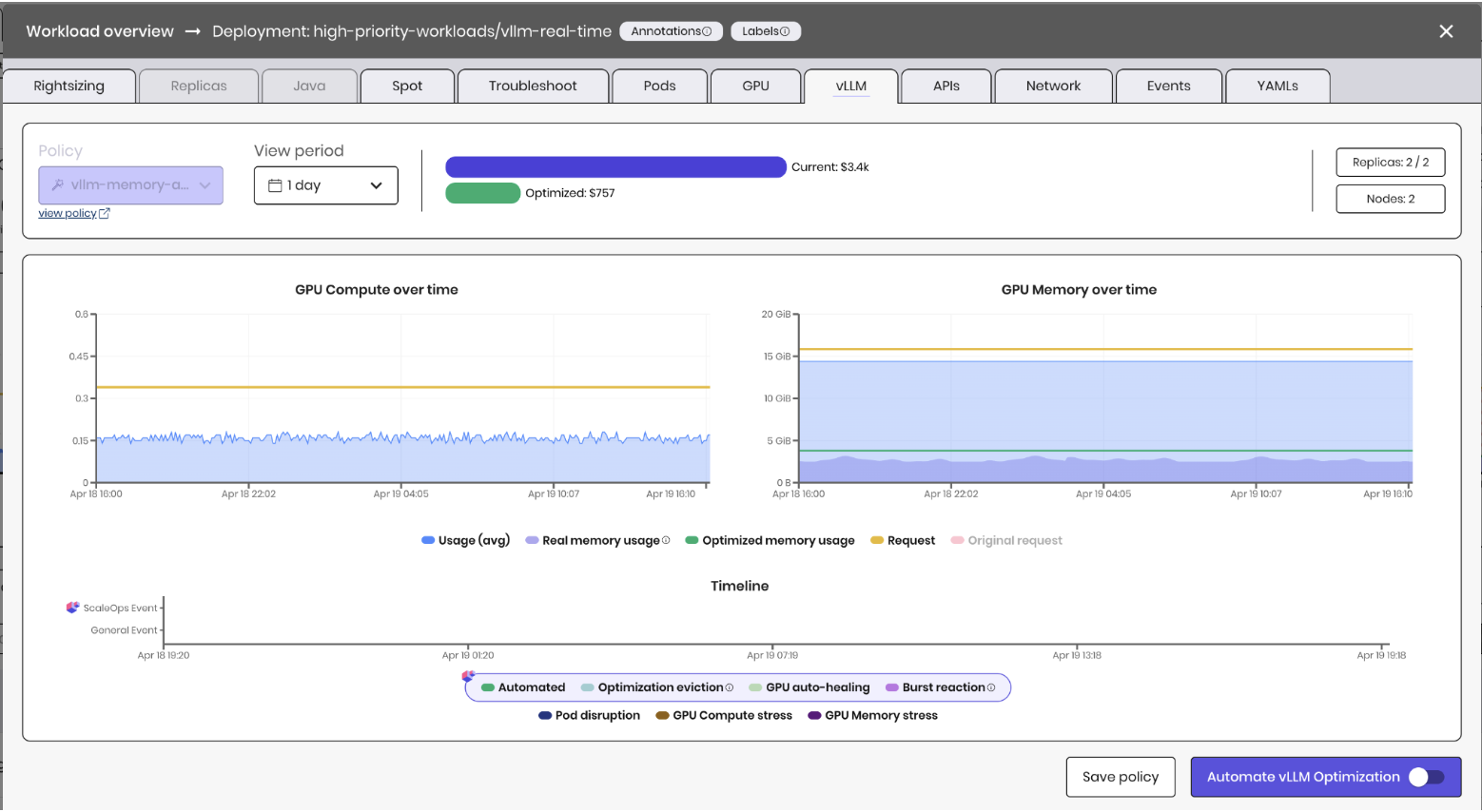
- GPU Memory Optimization for vLLM Workloads: Added accurate GPU memory recommendations for vLLM workloads based on real GPU memory usage, including model size, KV cache usage, and prefix hit rate. Learn more in the GPU Memory Optimization documentation.
- ScaleOps MCP: Introduced the ScaleOps MCP server, providing read-only access to ScaleOps insights — including cluster information, optimization opportunities, automation and troubleshooting capabilities. Learn more in the ScaleOps MCP documentation.
- Boot Time Optimization: Enhanced rightsizing recommendations for workloads with high CPU usage at boot time, improving recommendation accuracy and reducing performance risk at startup. Learn more in the Boot Time Optimization documentation.
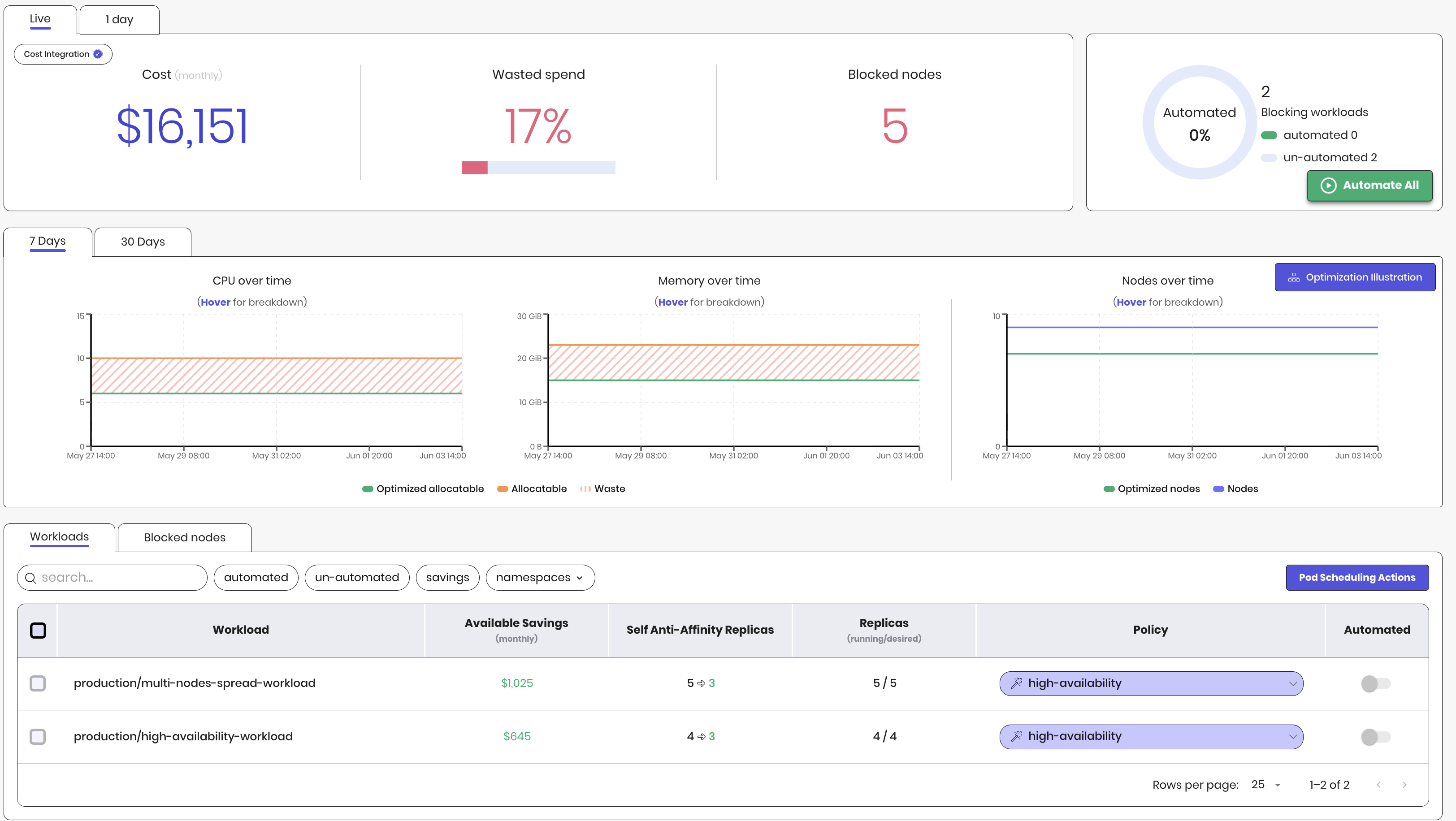
- Pod Scheduling: Introduced Pod Scheduling, which identifies workloads whose scheduling constraints — such as self pod anti-affinity — prevent underutilized nodes from scaling down, and safely relaxes those constraints to enable node consolidation. ScaleOps keeps replicas spread across a configurable minimum number of nodes and supports zone-level spreading, so availability is preserved while blocked nodes are freed for scale-down. Learn more in the Pod Scheduling documentation.
- Node Consolidation Instance Type Replacement for Karpenter: Added support for instance type replacement during node consolidation on Karpenter-managed nodes, enabling smarter bin-packing and greater cost savings. Learn more in the Node Optimization documentation.
Enhancements and Updates
- Replicas Downscaler Redesign: Redesigned the Replicas Downscaler feature with a new workload-level scheduling policy and an updated page layout for improved usability. Learn more in the Replicas Downscaler documentation.

- ScaleOps SRE Agent - Multi-Cluster Support: Extended ScaleOps SRE Agent with multi-cluster support, enabling AI-driven workflows and insights across multiple clusters from a single view.
- Node Optimization - Exclude Node Pools from Consolidation: Added support for excluding specific node pools from node consolidation, providing finer control over consolidation scope and addressing common customer requests.
- GPU Analytics Enhancements:
- Added multi-cluster GPU analytics for unified GPU visibility across clusters
- Added GPU Count column to the workload overview in GPU Analytics
- Added GPU cost per instance type graph for clearer cost attribution
- Added original vs. current GPU count graphs in workload and cluster troubleshoot
- Improved GPU analytics with new total GPU breakdowns
- Improved GPU unit price visibility across pages
- Added GPU total request to the GPU Resource Over Time graph
- Allocatable Comparison Enhancements:
- Added automation events graph to the Allocatable Comparison timeline
- Added GPU metrics and automation redesign to the Allocatable Comparison view
- Custom Workloads Enhancements:
- Added a new capability to simulate New COG impact before applying changes
- Added owner kind templates to Custom Workloads page graphs
- Workload Overview - New Filters Layout: Updated the Workload Overview to a new filters layout for a cleaner and more intuitive experience.
- Workload Troubleshoot Enhancements:
- Added event timeline to the workload troubleshoot page for clearer visibility into workload lifecycle events
- Added in-place skip reasons to workload overview timelines for better understanding of optimization blockers
- Added pod requests and usage graphs to the GPU workload troubleshoot view
- Added total pod count per GPU graph to the GPU workload overview
- Added workload type filter to the troubleshoot page for faster drilldown
- GPU Cluster Troubleshoot - New GPU Profile: Added a dedicated GPU profile to the cluster troubleshoot page for enhanced GPU-level diagnostics.
- Monitoring Troubleshoot - Exclusion Filters: Added support for exclusion filters in Monitoring Troubleshoot for more precise graph analysis.
- Node Load Metrics Graphs: Added new graphs for node load metrics, providing deeper visibility into node-level resource pressure.
- Reduced Graph Interval: Reduced the default graph data interval from 1 hour to 15 minutes across troubleshoot and monitoring pages, providing significantly higher resolution for performance analysis.
- Multi-Product Side Menu Restructure: Restructured the multi-product side menu for improved navigation and clarity across features.
- Rightsizing - Policy Limits Configuration via Helm: Added support for configuring policy limits behavior directly through the ScaleOps Helm chart.
- Java Autohealing Improvement: Improved the JVM Autohealing mechanism to only evict unhealthy pods, reducing unnecessary disruptions.
- vCPU Unit Price Visibility: Improved visibility of vCPU unit price across product pages for clearer cost attribution.
- Account Cost Page Improvements: Improved the AWS account cost page with clearer layout and additional cost metrics.
- Cost Insights - Total Cluster Cost: Added unfiltered total cluster cost display across pages for better cost awareness.
- Cloud SSO - Default Group Assignment: Added support for default group assignment for Cloud SSO users, simplifying access management.
- DaemonSet NodeSize - Dedicated Policy: Introduced a dedicated rightsizing policy for DaemonSet optimization by node size.
- GPU - Unified Automation with Rightsizing: Unified GPU automation and rightsizing into a single, streamlined flow, simplifying how GPU workloads are optimized and reducing configuration overhead. Learn more in the GPU Optimization documentation.
- GPU Rightsizing - CDI Device-List-Strategy Support: Added support for the CDI
device-list-strategyin GPU rightsizing automation, expanding compatibility for clusters using CDI-based GPU device management. - Workload Overview - Node Name in Timeline: Added node name to timeline node stress events in the Workload Overview for faster identification of the affected node.
- Allocatable Comparison - Instance Type Filter: Added an instance type filter to the Allocatable Comparison page for more granular analysis.
Fixes and Improvements
- OOM Autohealing: Improved OOM autohealing robustness for single-replica workloads and improved autohealing behavior for unhealthy workloads to ensure more reliable recovery.
- LimitRange Compliance: Fixed request rounding to ensure recommended values never violate configured LimitRange constraints.
- Dialog and Table Styling: Redesigned dialogs and refreshed product-wide table styling for a cleaner, more consistent UI.
Security
- Addressed CVEs: CVE-2026-32952, CVE-2026-40179, CVE-2026-42501, CVE-2026-33814, CVE-2026-45022, CVE-2026-42154, CVE-2026-42151, CVE-2026-45737, CVE-2026-45738, CVE-2026-45571, CVE-2026-34040
v1.30.0 (April 23, 2026)
New Features
- Node Consolidation for AWS with Cluster Autoscaler: Added support for node consolidation on AWS clusters managed by Cluster Autoscaler, expanding node consolidation capabilities on AWS clusters. Learn more in the Node Consolidation documentation.
Enhancements and Updates
- Karpenter Optimization Enhancements:
- Reserved Instances & Savings Plans Awareness: Enhanced Karpenter consolidation to account for reserved instances and savings plans.
- IP Allocation Limits Awareness: Enhanced Karpenter consolidation to account for IP allocation limits.
- Node Management - Support Karpenter + Cluster Autoscaler Configuration: Added support for node optimization features on clusters running both Karpenter and Cluster Autoscaler.

- Custom Owner Grouping by Container Regex: Added support for grouping workloads by container name regex, enabling accurate resource recommendations for workloads that share an owner but use different container names. Learn more in the Custom Workloads documentation.
- Improved GPU Node Consolidation: Improved the consolidation process of GPU nodes for GPU-automated workloads, enhancing the bin packing efficiency.
- GPU and GPU Optimization Observability:
- Added new p90 and max usage graphs to the Workload Overview for GPU workloads

- Added new graphs for GPU pods count per GPU device and per instance type in the Workload Overview

- Added a new GPU count by node instance type graph to the GPU Analytics page

- Replaced the GPU “Allocatable” metric with “Total GPUs” across resource-over-time and GPU Analytics graphs for clearer resource visibility
- GPU Node consolidation - Added indication to node blockers of CPU & Memory
- Added new p90 and max usage graphs to the Workload Overview for GPU workloads
- Java Optimization Improvements:
- Added JBoss JSON logging support for the JMX injector
- Added JMX exporter scraping support for Linkerd-enabled clusters
- Added Helm configuration to preserve custom
LD_PRELOADpaths during JMX injection
- Ephemeral Storage - Reduction Policy Flag: Added a policy flag to explicitly allow ephemeral storage reduction, giving teams more granular control over storage rightsizing behavior. Learn more in the Ephemeral Storage Rightsizing Documentation.
- Init Container Autohealing Improvements: Added the ability to configure ignored init containers and exit codes in init-container autohealing, with added support for Istio validation containers.
- Smart Policy for Argo Rollouts: Enhanced smart-policy logic for high-replica Argo Rollout workloads to improve recommendation accuracy.
- RBAC Configuration via Helm: Added support to configure RBAC rules directly through the ScaleOps Helm chart for improved permission management in GitOps workflows. Learn more in the Static RBAC rules via Helm chart documentation.
- Cost & Billing - Negotiated Discount Indicator: Added a negotiated discount indicator in the cost UI, providing clearer visibility into applied pricing adjustments.
- Tables Search Bar Improvements: Improved the global search bar experience across tables in the product for faster and more intuitive navigation.
Fixes and Improvements
- GPU Analytics: Improved total cluster resources, automation progress, and cost graphs on the GPU Analytics page.
- GPU Helm: Removed global
nodeSelector,Affinity, andTolerationsHelm values from capacity and provisioner pods to prevent configuration conflicts. - Workloads with Conflicting Label Selectors: Added support for workloads with conflicting label selectors to ensure correct recommendation handling.
- Peleg AI SRE Agent Enhancements: Added an automate-all button in the Peleg AI chat, enabling streamlined automation workflows directly from the AI agent chat. Peleg AI also now renders charts directly in the chat for richer, inline data visualization.
- Custom Annotations and Labels on Helm Resources: Added support for configuring custom annotations and labels on ScaleOps Deployments and DaemonSets via the Helm chart.
- Tooltip Synchronization in Troubleshoot: Improved tooltip synchronization across resource and troubleshoot charts in the Workload Troubleshoot view for better data correlation.
Security
- Addressed CVEs: CVE-2026-35469, GHSA-3xc5-wrhm-f963, CVE-2026-40179, CVE-2026-35206, CVE-2026-39882, CVE-2026-32280, CVE-2026-39883, CVE-2026-34986
v1.29.0 (March 23, 2026)
New Features
- Ephemeral Storage Rightsizing: Workload rightsizing now optimizes ephemeral storage requests, allocating each workload with the storage capacity it actually requires - ensuring optimal performance and driving cost savings. Learn more in the Ephemeral Storage Rightsizing Documentation

- Cluster Network Flow: Added a new cluster network map for AWS customers, visually mapping how your workloads communicate with each other and with external services. Learn more in the Network Map Documentation

Enhancements and Updates
- Java Optimization - New Page: Added a new Java Optimization page with an improved user experience and clearer automation. Learn more in the Java Documentation

- Allocatable Comparison Enahancements: Released multiple enhancements, improving usability and simplicity:
- Improved date picker UX
- Added cluster and node pool filters
- Added new metrics: origin requests, requests and usage

- Auto detection for Prometheus policy: Added auto detection for Prometheus policy
- Kubeflow built-in Custom Owner Groups: Added new built-in custom owner groups for Kubeflow workloads (PyTorchJob, TFJob, XGBoostJob, MPIJob, PaddleJob, JAXJob, KubeflowTrainer)
- Analytics - GPU Filters: Added GPU filters to Analytics and Allocatable Comparison pages
- Adoption Progress Bar: Added a new adoption progress bar to better show automation progress across features in the cluster and quickly identify optimization opportunities.
- DaemonSet optimization by node size - new enablement: Added an improved enablement panel for DaemonSet optimization by node size, including visibility available savings and underprovisioned DaemonSets.

- Network observability DaemonSet - Gradual enablement by default: The ScaleOps network observability DaemonSet that provides detailed network and API obersavility to each workload is gradually enabled by default for customers, to provide enhanced visibility and optimization in the cluster. For more information, reach out to ScaleOps support.
Fixes and Improvements
- Cluster Automation Permissions: Operators now require full cluster permissions
- Helm Improvements:
- Added support for configuring ignored HPA owners via Helm chart
- Added support to enable DaemonSet rightsizing by node size via Helm chart
Security
- Addressed CVEs: CVE-2026-24051, CVE-2026-27896, CVE-2025-15558, CVE-2026-25679, CVE-2026-27142, CVE-2026-33186, GHSA-6g7g-w4f8-9c9x, CVE-2026-33252
v1.28.0 (February 24, 2026)
New Features
- DaemonSet Optimization by Node Size: Introducing enhanced DaemonSet Rightsizing, generating tailored recommendations for each DaemonSet and node size combination. This ensures accurate resource allocation across clusters with mixed node sizes, preventing over-provisioning on smaller nodes and performance risk on larger ones. Learn more in the DaemonSet Rightsizing by Node Size Documentation.
- Peleg AI SRE Agent: Introducing Peleg AI SRE Agent, an in-product assistant that provides contextual, feature-aware answers to help users quickly understand capabilities, navigate workflows, and resolve issues faster. Peleg AI SRE Agent accelerates troubleshooting and decision making by delivering relevant guidance exactly when and where it’s needed. Learn more in the Peleg AI SRE Agent Documentation.

Enhancements and Updates
-
New main page - multi-cluster view with agentic insights: We have updated the main product page to be multi-cluster, along with a new layout that include recommended actions and agentic insights. The goal of the new page is to highlight savings opportunities and instant insights to into cluster health.

-
Custom Workloads Enhancements: Extended custom workloads built-in support
- Added built-in support to Argo Workflows custom owner
- Improved JenkinsJob detection
- Added built-in support to GitHubRunner workloads
-
GitOps Additions:
- Workload Automation control via Labels/Annotations: Added support to control workload automation and exclusion using custom Kubernetes labels and annotations, improving GitOps driven workflows. Learn more in the Workload Actions Documentation.

- Cluster Automation via Helm Chart: Added support to configure cluster level automation directly via Helm chart values, simplifying automation management. Learn more in the Cluster Actions Documentation.
- Workload Automation control via Labels/Annotations: Added support to control workload automation and exclusion using custom Kubernetes labels and annotations, improving GitOps driven workflows. Learn more in the Workload Actions Documentation.
-
Node Consolidation Schedule - helm support: Added support for node consolidation schedule configuration via helm.
-
API Observability: Added Full SSL and HTTPS capture, including Java and Golang services.

- Workload Rightsizing - Node Related Filters: Added new filters: nodes, node pools, instance types, tolerations and node blockers.

- In-Place Optimization - Limits Support: Added support for limits changes in in-place optimization. Learn more in the In-Place Optimization Documentation.
- GPU Rightsizing - Custom workload support: Added support to GPU rightsizing automation of custom workloads.
- Troubleshooting Enhancements:
- Added new aggregated graphs (avg, p90, p99, max) to the workload and cluster troubleshoot pages: Node Memory Utilization, Node CPU Utilization, Node Disk IOPS, Node Disk Throughput, Node Network Throughput, Pod Count per Node.

- Added healing graphs to cluster troubleshoot

- Added automation graph for all features in cluster troubleshoot

- Added new aggregated graphs (avg, p90, p99, max) to the workload and cluster troubleshoot pages: Node Memory Utilization, Node CPU Utilization, Node Disk IOPS, Node Disk Throughput, Node Network Throughput, Pod Count per Node.
- Node Consolidation Redesign: Redesigned node consolidation page for clearer visibility into potential savings and an improved overall experience.

Fixes and Improvements
- Karpenter Optimization Improvements:
- Instance size improvements: Improved Karpenter recommendations to avoid suggesting instances that are too small, ensuring workload stability and performance.
- Upgraded node pool instance types UI: Improved the UI for simpler visibility to instance type recommendations

- Preference policy automation events: Added preference policy automation events to timeline and analytics.

- OpenShift Improvements:
- Pod placement is now enabled by default on OpenShift clusters.
- Node blockers are now shown by default on OpenShift clusters.
- Cost calculations are now aligned with allocatable resources on OpenShift clusters for improved accuracy.
- Installation: Added support of
managedStorageClasshelm flag for different storage class migration. - User Management Improvements: Added search, filters and pagination to user & groups pages.
Security
- Addressed CVEs: CVE-2025-68121, CVE-2026-25934
v1.27.0 (February 1, 2026)
New Features
- Replicas Downscaler: Replicas Downscaler enables scheduled reduction of workload replicas during defined time periods (e.g off-hours, weekends). Use Replicas Downscaler to reduce costs by automatically scaling down workloads, and automatically scale up when necessary. Learn more in Replicas Downscaler Documentation.

- Java Optimization for Spark workloads: Added Java memory visibility and optimization for Spark Executor workloads. Learn more in the Java Optimization Documentation.
- Spot Optimization for Spark Workloads: Run Spark workloads on Spot instances with workload auto detection of spot friendly workloads, ensuring job resilience to spot evictions while maximizing cost savings. Learn more in the Spot Optimization for Spark Documentation.
- Replicas Optimization - Schedule Policy: The schedule policy lets you automatically switch Replica Optimization policies by time, like business hours, nights, weekends, or peak windows. Define a default policy and ordered time based override rules so the right scaling behavior is applied exactly when you need it. Learn more in the Documentation.
- Karpenter Optimization - Preference Policy Optimization: Optimize Karpenter preference policy to improve bin-packing efficiency while respecting hard preference constraints. Learn more in the Karpenter Optimization Documentation.
- DaemonSet Rightsizing by Node Size: Generate tailored resource recommendations for DaemonSets by grouping pods by their parent DaemonSet and node size, and generating recommendations for each combination. This ensures optimal savings and performance for each DaemonSet, as pods running on different node sizes receive the resources they need. Learn more in the DaemonSet Rightsizing by Node Size Documentation.
Enhancements and Updates
-
In-place optimization is GA: In-place rightsizing is now GA, and enabled in all default policies for workloads with ongoing optimization strategy. Learn more in the In-place Documentation.
-
Advanced Performance Dashboard: Added Advanced Performance dashboard in workload overview and cluster troubleshooting, with variety of performance insights for enhanced troubleshooting.

-
AWS Cloud Integration - New page design: Improved the design of the AWS Cloud Integration for clearer integration steps and status.

-
Replicas optimization Support for Custom Workloads: Added support for custom workloads in Replicas Optimization. Read more about Custom Worklads.
-
Exclude workload types from automation: Added support to exclude specific types from automation via the UI and GitOps.
-
Cluster Troubleshoot Enhancements: Added multiple new graphs to the Cluster Troubleshoot page
- Allocatable analysis: Added allocatable, request increase and pod increase graphs to better analyze increase in allocatable CPU and memory

- Node analysis: Added Nodes per Node Pool and Node Disruptions graphs


- Allocatable analysis: Added allocatable, request increase and pod increase graphs to better analyze increase in allocatable CPU and memory
-
Workload Troubleshoot Enhancements: Added multiple new graphs to the Workload Troubleshoot page
- Automation graph: Improved the automation graph to show automation status of all features

- HPA and Pod Lifecycle: Added HPA and pod lifecycle duration metrics and graphs

- Pod Count Per Node Pool: Added new Pod Count per Node Pool graph for Karpenter

- GPU Inference Servers: Added new Triton and vLLM graphs

- Automation graph: Improved the automation graph to show automation status of all features
-
Replicas Optimization - Argo Rollout support: Added support for ArgoRollout workloads defined with WorkloadRef.
-
Exclude/include namespaces: Added support to exclude/include namespaces from automation using helm values.
-
GPU Optimization Time-slicing Visibility: Added full visibility for NVIDIA time-slicing clusters, including visibility for physical GPUs in cluster, GPU slicing requests and nodes with time-slicing

-
Cloud SSO: Added an option to disable social login for SSO users, to simplify and streamline login experience.
-
User Activity Audit Logs: Addedd login events in audit logs, and login statistics in the user management table.
-
Cluster Headroom Enhancements:
- Expanded the dynamic headroom configuration to allow exceeding 100% of cluster capacity.
- Added ability to select specific times (minute granularity) for cluster headroom schedule.
-
Out-of-the-box support for new Custom Workloads:
- GitLab Runner workload type is now supported as a built-in custom workload
- Airflow workload type is now supported as a built-in custom workload
Fixes and Improvements
- Added official support for the OpenShift operator version
v4.20 - Node Consolidation Improvements:
- Enhanced timeline consolidation events to include consolidation savings

- Added skip consolidation events to timeline

- Enhanced timeline consolidation events to include consolidation savings
- Installation Enhancements:
- Added support to configure previously defaulted ignored namespaces
- Added the ability to add labels and annotations specifically to ScaleOps mutating webhook
- GPU Rightsizing Improvements:
- Added detected inference server tag in workload overview
Security
- FIPS base images: Changed FIPS base images to be STIG hardened
- Addressed CVEs: CVE-2025-68476, CVE-2025-68156, CVE-2025-68973, CVE-2025-61726, CVE-2025-61731, CVE-2025-68119, CVE-2025-61728, CVE-2025-61730
- Added Helm support for removing nodes/proxy ClusterRole: You can now opt out of granting node-level proxy permissions via
global.rbac.disableNodesProxyClusterRoleHelm flag.
v1.26.0 (December 22, 2025)
New Features
- Cluster Headroom: Introducing enhanced Cluster Headroom feature, enabling precise, policy-driven capacity reservation so new workloads can be scheduled immediately without waiting for node scale-up. Granular targeting, dynamic headroom, and lifecycle awareness improve scheduling reliability and scaling behavior while reducing overprovisioning, with full support for GitOps workflows. Learn more in the Documentation.

Enhancements and Updates
-
FIPS-compatible image: ScaleOps now provides a FIPS-compatible image, allowing customers to safely install and run ScaleOps in FedRAMP environments. Read more in the installation instructions
-
In-place optimization support for custom and single replica workloads: Expanded support for in-place workload rightsizing now available for workloads defined with Custom Owner Grouping, and for single replica workloads.
-
Node optimization: Added node optimization events timeline for clear impact visibility over time.

-
Auto Healing in Automated Fractional GPUs: Added auto-healing support for GPU workloads to ensure faster recovery and improved reliability.
-
GPU Bottlerocket AWS AMI Support: Added support for GPU automation with default volume-mount configurations in Bottlerocket AWS AMI.
-
Audit for GitOps Events: Improved Events coverage with added logging of GitOps events on workloads (annotations), namespaces (annotations / AutomatedNamespace CRD), and cluster (ConfigMaps).
-
Node overview troubleshoot enhancement: Expanded node overview troubleshoot panel to include dashboard support, enhancing the analytics capabilities within the node overview.

-
Spot optimization: Added 30 days view to Resource Over Time, for increased historical view of Spot Optimization resource graphs.
-
Improved replicas optimization filters: Added optimization gap filters for replicas optimization, allowing to quickly identify and fix workloads blocked from optimization.

Fixes and Improvements
-
Spot Optimization - PDB Management Enhancement: Improved handling of PDB and auto-detection logic in Spot Optimization.
-
Java workloads auto-detection improvements: Improved the auto-detection mechanism of java workloads, including out of the box support for Wildfly and Apache Solr based workloads.
-
Fixed display of inactive custom workloads: Fixed bug causing custom workloads with no running pods to be hidden from the UI.
Security
- Addressed CVE: CVE-2025-61729.
v1.25.0 (November 24, 2025)
New Features
- Java Optimization: Automate Java memory optimization by analyzing heap configuration and usage in real time. The platform dynamically manages Java heap allocation and the workload’s memory requests to reduce waste while maintaining performance and reliability. Learn more in the Java Optimization Documentation.

- Node Consolidation Schedule: Added support for configuring node consolidation schedules to run automatically at predefined times.

Enhancements and Updates
- GPU Optimization with MPS: ScaleOps new policy-based support for MPS GPU sharing strategy, enabling more efficient GPU utilization through NVIDIA’s MPS technology

- GPU Troubleshooting Graphs:
- GPU Workload Troubleshooting: Added new GPU troubleshooting graphs to the workload overview.

- GPU Node Troubleshooting: Added new GPU troubleshooting graphs to the node overview.

- GPU Workload Troubleshooting: Added new GPU troubleshooting graphs to the workload overview.
- Workload Network Flow Visualization: Added workload network flow chart to improve visibility and usability when analyzing connections and dependencies.

- Terminated Nodes Visibility: Added visibility for terminated nodes for better resource lifecycle tracking.

Fixes and Improvements
Security
- Addressed CVEs: CVE-2025-31133, CVE-2025-52565, CVE-2025-52881, CVE-2025-58181
v1.24.0 (November 12, 2025)
New Features
- Automated GPU-Based Workload Rightsizing (Beta): Introduced automated, real-time GPU workload rightsizing to maximize GPU utilization and reduce costs. Learn more in the GPU Optimization Documentation.
- Fractional GPU Allocation: GPU sharing across pods for higher utilization and reduced waste.
- Automated GPU Rightsizing: Policy-driven rightsizing for GPU-based workloads.
- App Context-Aware Scheduling: Smart pod scheduling to optimize bin-packing and maximize node utilization.

Enhancements and Updates
- Node Optimization - Consolidation Menu Update: Enhanced the node consolidation menu with separation between Optimization and Observability sections.

Security
- Addressed CVEs: CVE-2024-25621.
v1.23.0 (November 5, 2025)
New Features
-
Init Container Optimization: Introduced automated optimization for init containers, minimizing overprovisioning while providing enhanced visibility into their performance and impact on overall workload rightsizing. Learn more in the Documentation

-
Spot & Node Optimization Support for Karpenter in AKS: Spot optimization and Node optimization features are now available for AKS clusters with Karpenter. Learn more in the Spot Optimization Documentation and Karpenter Optimization Documentation.
-
Cost Comparison Page: Introduced a new page that allows comparing two time periods side-by-side to measure optimization impact, automation progress, and cost savings. Learn more in the Documentation.

Enhancements and Updates
-
Workload Rightsizing
- Original Limit Display: Added original limit display to workload overview, providing clearer visibility into limit changes and optimization over time

-
Node Optimization
- Enhanced Consolidation Status Display: Enhanced the status display to provide clearer visibility into the node consolidation process.

- Exclude GPU Nodes: Added an option to exclude GPU nodes in node consolidation.
- Enhanced Consolidation Status Display: Enhanced the status display to provide clearer visibility into the node consolidation process.
-
Billing Page: Introduced a new page that displays an estimated CPU allocation used for billing calculations, providing greater transparency and insight into billing calculations. Learn more in the Documentation.
-
Troubleshooting
- Cluster Troubleshoot Graphs
- Karpenter Node Consolidation Decisions graph: providing clearer visibility into Karpenter-driven node lifecycle events and consolidation.
- Karpenter Node Pool Monitoring: Introduced Karpenter node pool utilization graphs, enhancing visibility into node pool resource usage and capacity planning.
- Prometheus Insights: Added Prometheus Volume and Retention graphs to help users monitor resource persistence and usage patterns.
- Memory/CPU Requests by Workload Type: Added graphs for CPU and memory requests by workload type, for clearer sizing of requests across the workload types.
- Automation Filter: Added a new filter for automated and non-automated workloads in the Troubleshoot page, improving workload diagnostics.
- Cluster Troubleshoot Graphs
Fixes and Improvements
- Improved UX for Google Cloud Integration: Improved overall experience for Google Cloud - showing what services accounts are lacking permissions.
- Resource Analytics: Updated top panel to display automation across all features.
- Helm Chart - Topology Spread Constraints: Added support for
topologySpreadConstraintsin Helm.
Security
- Addressed CVE’s: CVE-2025-53905, CVE-2025-53906, CVE-2025-58188 and CVE-2025-61725.
v1.22.0 (October 9, 2025)
New Features
- SSO & Group-Based Authorization in ScaleOps Cloud: ScaleOps Cloud now supports SSO and Group-Based authorization. Learn more in the Documentation
Enhancements and Updates
- Node Management & Optimization
- Karpenter Optimization - Improved Instance Type Recommendation Logic: Recommendations will now account for MaxPods limits.
- Optimization Indicators to Node Pools: Added optimization indicators to Node Pools, improving clarity on optimization status of each node pool.

- Updated Node Pool Changes View: Added View changes button and modified Actions button in the Edit Node Pool screen.

- Node Consolidation
- Karpenter v1 Support: Karpenter v1 is now supported in Node Consolidation feature.
- Nodes to be drained: Added display of nodes to be drained by the consolidation.

- Node Overview - Automated Pods Indication: Added automation indicators in the Pods Table within Node Overview.

- Replicas Optimization
- High Availability Auto-Detected Policy: Introduced new
high availabilityauto-detected policy, automatically assigned to workloads that require a higher minimum replicas.
- High Availability Auto-Detected Policy: Introduced new
- Workload Rightsizing
- Custom Workloads: Added option to set weight on the COG for priority in case of multiple matches, using
.spec.weightattribute in the COG CR. - Limits in Workloads Table: Added limits columns to the workloads table.
- Custom Workloads: Added option to set weight on the COG for priority in case of multiple matches, using
- Monitoring & Analytics
- Resource Analytics - Node Optimization Graphs: Added Node Optimization Events and Optimized Nodes graphs.

- Node Pool Events: Added Node Pool events for actions initiated by ScaleOps.
- Resource Analytics - Node Optimization Graphs: Added Node Optimization Events and Optimized Nodes graphs.
- Platform Improvements
- Custom GPU Pricing: Added support for custom GPU pricing in dashboard cost settings.
- GPU Filter in Spot & Replicas Optimization: Added a GPU filter on the workloads overview in Spot Optimization and Replicas Optimization.
- Exclude from Automation Applies to all features: Exclude from automation now applies across all features and automation types.
Fixes and Improvements
- UX/UI Improvements
- New Filters Design: Introduced new filters design across the UI, allowing easier filtering and clearer view of applied filters.

- Actionable Item Design in Sidebar: Added indication for actionable items in the sidebar for improved clarity on pages with optimization actions.

- New Filters Design: Introduced new filters design across the UI, allowing easier filtering and clearer view of applied filters.
- Security
- Addressed CVE’s: CVE-2025-32988, CVE-2025-32990, CVE-2025-6395, CVE-2025-59531, CVE-2025-59537, CVE-2025-59538, CVE-2025-55191.
v1.21.0 (September 1, 2025)
New Features
- Node Optimization - Azure and GCP: ScaleOps’ Node Optimization feature reduces Kubernetes infrastructure costs by consolidating and optimizing AKS and GKE nodes, leading to reduced node-level waste. See Node Optimization Documentation.

Enhancements and Updates
-
Enhanced GitOps Support: Added support for default automation & policy for Pod Placement, Spot Optimization and Replicas Optimization, and updated existing GitOps support for Workload Rightizing. The feature supports workload, namespace and cluster level automations and policy assignment. Read more in the Documentation.
-
Spot Optimization Support for workloads with PDBs: Added optimization support for workloads with existing PDBs by default.
-
Replicas Optimization: Added support for
Argo RolloutsandStatefulSets. -
Workload Rightsizing
- Exclude Workload from Automation: Added UI support to exclude workloads from automation. The feature allows to exclude a single workload or selected workloads in bulk, providing finer control on the automation process.

- Updated Policy Creation: ScaleOps auto-detected policies (Java, Spark, etc) are now created by default upon installation or upgrade, rather than upon workload detection.
-
Workload Troubleshoot:
- Added a new ScaleOps Healing Statuses graph, showing Auto Healing and Burst Reaction status over time.

- Added a new ScaleOps Healing Statuses graph, showing Auto Healing and Burst Reaction status over time.
-
Cluster Troubleshoot:
- Added new Automated Workloads and Optimized Pods graphs.

- Added new Automated Workloads and Optimized Pods graphs.
Fixes and Improvements
-
Node Management AWS (Karpenter):
- Removed the ability to delete node pools from the UI for increased safety.
- Updated the layout of node pools page, simplifying optimization actions.


-
Workload Rightsizing:
- Added an indication in the Workload Rightsizing menu for un-recognized CPU shown in the custom workloads page.

- Argo Rollouts now appear in search and are filterable by label.
- GPU and HPA filters now support an exclude option.
- Updated Workloads On Stressed Nodes display in Workload Rightsizing top section panel.

- Added an indication in the Workload Rightsizing menu for un-recognized CPU shown in the custom workloads page.
-
Nodes page:
- Added GPU node filter.
- Fixed missing lifecycle display in node overview.
- Fixed redirect from pod table to workload details for Argo Rollout workloads.
- Fixed incorrect “Not Ready” display status in node overview.
-
UX:
- Added description to the Optimization Events tooltip, describing the reason for the eviction (Workload Rightsizing, Spot optimization, etc).

- Added a new button to quickly access All Clusters Overview.

- Added Resources Analytics page under overview section.
- Standardized naming across the product for Replicas Optimization, replacing instances of “HPA”.
- Updated terminology across the product, replacing Rollout with Argo Rollout.
- Added description to the Optimization Events tooltip, describing the reason for the eviction (Workload Rightsizing, Spot optimization, etc).
v1.20.0 (August 10, 2025)
New Features
- Spot Optimization for GKE: Expanded Spot Optimization support to GKE clusters using Cluster Autoscaler, bringing intelligent pod-level scheduling between Spot and On-Demand instances to GCP environments. See the Spot Optimization (GCP) Documentation.
- Cost Integration for GKE: Added integration to Google Cloud Billing for enhanced cost visibility and reporting. See GCP Cost Integration Documentation.

Enhancements and Updates
-
Workload Rightsizing:
- New In-Place Policies (Beta): Added 2 new built-in policies -
production-in-placeandhigh-availability-in-placewhich are equivalent to the existingproductionandhigh-availabilitypolicies, with in-place optimization enabled by default. See In-Place Optimization Documentation. - Improved handling of high CPU at boot: Enhanced handling for workloads with increased boot-time CPU usage, enabling faster recovery from insufficient CPU resource requests.
- Java Policy Refinement: Refined the Java Policy to reduce disruptions and improve stability for Java workloads.
- New In-Place Policies (Beta): Added 2 new built-in policies -
-
Troubleshooting & Monitoring:
- New Unready Pod Events Graph: Added Unready Pod Events graph to Workload Troubleshoot, visualizing unready pod events over time and making it easier to detect and analyze workload instability.

- New Container Exit Codes Graph: Added Container Exit Codes graph to Workload Troubleshoot, showing exit codes over time per workload.

- Java events in OOM Graphs: Added indication for OOM events by Java to the Out of Memory Graphs in Cluster Troubleshoot and Workload Troubleshoot.

- New Unready Pod Events Graph: Added Unready Pod Events graph to Workload Troubleshoot, visualizing unready pod events over time and making it easier to detect and analyze workload instability.
Fixes and Improvements
- Pod Disruptions Troubleshooting: The Pod Disruptions graph now excludes CronJob pod completions events, to enhance clarity and accelerate troubleshooting.
- Clarified Optimization Gap for Required History Coverage: The UI will now indicate the remaining time until optimization for workloads with policies that require historical window coverage.

v1.19.0 (July 21, 2025)
New Features
- Spot Optimization for AKS: Expanded Spot Optimization support to AKS clusters using Cluster Autoscaler, bringing intelligent scheduling between Spot and On-Demand instances to Azure environments. See the Spot Optimization (Azure) Documentation.
- Cost Integration for AKS: Added support for Cost Management and Billing on AKS for enhanced cost visibility and reporting. See AKS Cost Integration Documentation.
- AKS Node Pools Management: Introduced Node Pools management for AKS clusters, providing visibility and control over node pool configurations and scaling parameters.

- Universal Search: Added powerful cross-product search via
cmd+kfor instant navigation and discovery throughout the platform.
- Debug Data Export: New capability to export comprehensive debug data from the Settings page, especially valuable for air-gapped environments and troubleshooting analysis.

Enhancements and Updates
-
Troubleshooting & Monitoring:
- New Graphs: Added several new graphs including pod count per node capacity and pod count per node name.

- Cluster Troubleshooting: Added new workloads filter for better drilldown into specific workloads and relevant nodes.

- Workload Overview: Added additional columns in the Pods tab, including Node name, Node capacity type, Affinity, Node selector, and more.
- Resource Analytics Page: Added Estimated original allocation legend to the resource graph, showing the estimated allocatable resources without ScaleOps optimizations.
- New Graphs: Added several new graphs including pod count per node capacity and pod count per node name.
-
Rightsizing & Automation:
- Java Policy: Introduced new Java policy to better handle JVM overhead and startup requirements, automatically applied to auto-detected Java workloads.
- Automate Now: Added an Automate Now button for one-click automation of all eligible workloads across Replicas optimization, Pod placement, Spot optimization, and Overview pages.

- RightSizing Page: Updated the under-provisioned workloads to present count of under-provisioned pods on CPU stressed nodes, and workloads having OOMs on highly memory utilized nodes.

- RightSizing Policy Rules: Removed Environment Keys rule type option from RightSizing Policy Rules from the UI.
- RightSizing Policy CRD Cleanup: Cleaned up the RightSizing Policy CRD to remove unused and deprecated fields. For more details, please contact the ScaleOps support team.
-
UI/UX Enhancements:
- Product UI Enhancements: Refined design and various UI improvements throughout the platform.
- Multi-Cluster UI: Clusters dropdown now presents automation progress per cluster and feature.
- Multi-Cluster Dropdown: Redesigned the Multi-Cluster dropdown for improved usability and clearer cluster selection.

- Refreshed Platform Colors: Updated platform colors for improved visual clarity.
-
Helm Configuration:
- Fixed an issue with custom assignment for the
serviceAccount.nameHelm field. - Added
global.configMap.annotationsandglobal.secret.annotationsHelm flags to allow custom annotations on ScaleOps-chart created ConfigMaps and Secrets. - Added support for configuring cost settings (e.g., negotiated discounts) via the Helm chart.
- Fixed an issue with custom assignment for the
-
Performance:
- ScaleOps Dashboard Performance: Significantly reduced load times across platform pages and graphs.
v1.18.0 (June 25, 2025)
New Features
- Spot Optimization (Beta):
Introduced the Spot Optimization feature for intelligent scheduling between Spot and On-Demand instances, currently supported in AWS clusters with Karpenter. ScaleOps analyzes workloads and automatically shifts replicas to Spot nodes while keeping required replicas on On-Demand for stability. See the Spot Optimization Documentation for more details.

Enhancements and Updates
-
Replicas Optimization:
- Replicas Optimization is now generally available (GA). See Replicas Optimization Documentation.
-
Rightsizing & Automation:
- Node-stress AutoHealing now considers under-provisioned, unhealthy pods with upon-pod-creation strategy for eviction (see AutoHealing Documentation).
- Introduced the Automate All button on the Rightsizing page, allowing users to automate all workloads in a single click.

-
Monitoring & Troubleshooting:
- Improved graph latency on the cluster troubleshoot page for a smoother and faster user experience.
- Added a new Pod Status Phase graph in the workload troubleshoot page for better visibility into pod lifecycle states.
- Added new graphs to the cluster troubleshoot page, including Pod Count and HPA Resource Trigger Changes.
-
UI/UX Improvements:
- The Overview page is now the main landing page in the UI for easier navigation.
- Moved the “Savings Results” menu item under the Monitoring section for improved menu organization.
- Updated the unevictable workloads table to clarify column names and improve user experience.
v1.17.0 (June 5, 2025)
New Features
-
In-Place Pod-Optimization Support: ScaleOps now supports in-place pod optimization for seamless RightSizing updates with minimal disruption. Supported with k8s v1.33+. Refer to In-Place Optimization Documentation.

-
Node Optimization: ScaleOps’ Node Optimization feature reduces Kubernetes infrastructure costs by optimizing Karpenter configurations to eliminate node-level waste. Supported with Karpenter v1 on AWS. Refer to Node Optimization Documentation.


Enhancements and Updates
- Workload Automation:
- Container Restarts: Added new Container Restarts graph in workload troubleshoot.
- Auto-Detection Enhancements: Added auto-detection for Cassandra, ClickHouse, and OpenSearch workloads, now assigned with high-availability policy.
- Elasticsearch Detection: Improved Elasticsearch auto-detection to cover more patterns.
- Troubleshooting:
- SystemOOM Visibility: Added visibility into SystemOOM events in Workload Troubleshoot, shown when a pod restart occurs near a system-level OOM.
- Node Condition Graphs: Added Node Condition graphs to display conditions like MemoryPressure, PIDPressure, Unknown, and more in Troubleshoot Pages.
- ScaleOps Optimization Evictions: The ScaleOps optimization evictions graph has been merged into the pod disruption graph in workload and cluster troubleshoot pages.
- Node Management:
- Volumes Column: Added a Volumes column to the pods table in Node Overview, highlighting attached volumes and local storage that may block scale-down.
- UI/UX Improvements:
- Optimization Gap Filter: Added optimization-gap filter in workload rightsizing page.
- Policy YAML Cleanup: Cleaned up undesired metadata fields in UI Policy YAML to simplify copy-and-apply workflows.
- Graph Color Consistency: Improved graph legends color consistency across the platform.
- GitOps & Automation:
- GitOps Support: Added GitOps support for resetting workload UI control.
- HPA Policy: Added HPA policy functionality to configure whether to min-cap min-replica recommendation with the original value.
- Performance & Reliability:
- Monitoring Performance: Improved disruption and downtime graphs latency in Monitoring page UI performance.
- Recommendation Creation: Increased rate of recommendation creation to improve landing experience.
- Multi-cluster Performance: Improved multi-cluster performance.
- Admission Readiness: Enhanced admission readiness mechanisms for improved stability.
- System Updates:
- Prometheus Upgrade: Upgraded Prometheus from v3.0.0 to v3.4.0.
- Ignored Namespaces: Resolved an issue that triggered unintended Rollouts and false Automation events in the troubleshooting page for workloads in ignored namespaces.
v1.16.0 (May 7, 2025)
New Features
- AWS CUR Integration: Introduced AWS Cost and Usage Report (CUR) integration, providing accurate cost data. Refer to Cost Integration Documentation.


-
Rightsizing Policy Rules: Users can now define custom rules to automatically assign custom policies to workloads based on pod-level criteria such as labels, annotations, or environment variables. Refer to Policy Rules Documentation.

-
Custom Workloads Page: Introduced a new page for managing Custom Workloads, offering enhanced management capabilities and improved visibility into both recognized and unrecognized pods. Refer to Custom Workloads Documentation.

Enhancements and Updates
- Replicas Optimization Policies:
- Introduced New Replicas Policies to enhance scaling flexibility, including performance policy with more conservative scaling, cost policy for additional savings, and predictive policy to optimize predictive workloads only.

- Added Min Replicas Headroom policy field to allow additional replicas on top of the min-replicas recommendation.

-
Rightsizing Policies: Added a memory replicas percentile policy field to provide finer control over the replicas used in recommendation calculations, useful for workloads with a high number of replicas.

-
Workload Overview: Added Pods tab, presenting the current state of the workload’s pods.

-
Alerts: Prometheus Alert Manager integration support including built-in predefined ScaleOps alerts. Refer to the Alert Manager Documentation.
-
Cluster Events: Added support to export events to CSV.

-
Installation:
httpsProxyhelm flag support for environments behind a proxy.global.commonLabelshelm flag support for adding common labels to all ScaleOps resources.global.pdbhelm flag support for PodDisruptionBudget to all ScaleOps pods.values.yamlcleanup by removing deprecated fields and reorganizing the values for better readability.
- Performance Improvements: API-server load from ScaleOps has been reduced, improving platform stability and performance.
v1.15.0 (April 03, 2025)
New Features
- New Users Page: We’ve introduced a new Users page, allowing admins to manage users and their roles more effectively. This page provides a comprehensive overview of all users, their roles, and the ability to add or remove users as needed.

- Cluster Headroom: The Cluster Headroom feature is now generally available, enabling easy configuration of both proportional and static headroom across Spot and On-Demand capacity. This helps ensure faster scheduling and smoother scaling during traffic spikes (see documentation).

Enhancements and Updates
- Workload automation:
- The auto-healing mechanism has been enhanced to better detect and recover from node stress conditions, improving resilience and stability during high-load scenarios.
- Improved handling of edge cases involving node resource capping ensures more accurate and reliable RightSize recommendations.
- Kafka StrimziPodSet is now automatically detected and supported for rightsizing optimization.
- Pod Placement:
- Enhanced Resource Graph Tooltips: The resource utilization graph now shows detailed waste breakdowns by reason in tooltips—making it easier to understand where and why node resources are being underutilized.
- Automation and rollout buttons have been refined with clearer tooltips and visuals.
-
Troubleshooting: The ScaleOps issues graph is now grouped by type, making it easier to identify ScaleOps internal issues.
-
ScaleOps Platform: Introduced new call-to-actions in the platform main menu, including indications for actions with available savings

-
Helm Configuration: Added support for Istio
VirtualServicein Helm chart (see documentation). -
UX Enhancements:
- New Auto-Detected Workloads Filter: Easily filter and identify workloads such as Redis, Kafka, Flink, Spark, Memcached, and more with the new auto-detected workloads filter.
- HPA workload overview now includes a direct link to view the associated HPA policy for faster analysis and tuning.
v1.14.0 (March 13, 2025)
New Features
- New Overview Page: We’ve introduced a new centralized dashboard showcasing all product features, per-feature progress, savings, cost insights, and optimization potential, with direct links for deeper analysis.

- Multi-Cluster Overview: The Multi-Cluster Overview page has been redesigned for clearer value insights and progress tracking per cluster.

Enhancements and Updates
- HPA Optimization:
- Added a Max Replicas column to the HPA Workloads table.
- HPA Workload overview now includes a timeline view to track automation state progress.

- Nodes:
- Lifecycle Filter: Added a Lifecycle filter for improved node filtering.
- Added “requirements” column to the Karpenter NodePools table.
- Karpenter NodePool v1 Support: Added visibility for Karpenter.sh/v1 NodePools in the Nodes page.
- Clickable NodePools: Node-pool rows are now clickable, displaying the NodePool YAML upon selection.

- Monitoring and analytics:
- Improved automation progress and resource optimization visibility for HPA, Rightsizing, and Pod Placement with clearer graph sections.
- Rightsizing and HPA Graphs across product: Added origin resource lines for better comparison in rightsizing resource graphs.


-
RightSize Optimization: Improved AutoHealing efficiency for better node stress handling.
-
Workload Overview: Added a direct link to policy settings from the workload overview for easier access.
-
Workload Auto-Detection: Added a new auto-detected policy, daemonset-workloads, designed specifically for daemonsets. This policy is automatically applied to daemonset workloads for optimized resource recommendations.
-
Performance Improvements: Improved multi-cluster UI performance and stability, including faster loading times and reduced latency between clusters and aggregated clusters views.
-
Saving Results: Enhanced the Savings Results page with new columns to showcase HPA optimization impact, including HPA Optimized, HPA Replicas Saved, and HPA Optimized Replicas.
-
Helm Configuration: Added support for the
excludeDaemonSetRightsizingflag to exclude DaemonSet rightsizing automation. -
Authentication: Added custom admin password support.
v1.13.0 (March 2, 2025)
Enhancements and Updates
- UX Enhancements: We’ve introduced a new menu design to enhance user experience and make navigation more intuitive. The new menu design includes a Side Menu and Multi-Cluster Dropdown, providing users with easy access to different sections of the platform.


-
Workload Automation: ScaleOps now supports Kubernetes native sidecar containers, allowing users to optimize workloads with sidecar containers more effectively. The platform can now detect sidecar containers and provide accurate resource recommendations for these workloads and visibility, treating native sidecars like regular containers.
-
Workload Auto-Detection: A new auto-detected rightsizing policy, high-replica-deployments, has been introduced. This policy is specifically designed to improve the stability of deployments containing more than 100 replicas.
-
RightSize Optimization: Improved AutoHealing to more quickly and accurately detect CPU-stressed nodes, leading to better healing of under-provisioned pods.
v1.12.0 (February 23, 2025)
New Features
- Predictive HPA: We’ve introduced the Predictive HPA (beta) to enhance the efficiency of Horizontal Pod Autoscalers (HPAs). Predictive HPA leverages predictive algorithms to estimate application metric levels and ensures that workloads are running with the efficient number of replicas. See our Predictive HPA (beta) documentation for more details.

-
ScaleOps Cloud: ScaleOps Cloud Hosting is now available, offering a seamless SaaS-like experience without storing or hosting sensitive data. It enables effortless deployment and includes user management, allowing admins to invite and remove users, assign roles (Admin, Operator, Viewer), and control access easily. See our ScaleOps Cloud documentation for more details.
-
Workload APIs: The Workload APIs tab (beta) provides visibility into workload performance and reliability for HTTP and HTTPS traffic, powered by eBPF. This feature allows users to monitor and optimize API performance. See our API Observability (beta) documentation for more details.

Enhancements and Updates
- Cluster and workload troubleshooting: We’ve introduced a new troubleshooting page design, offering enhanced troubleshooting capabilities, including defining custom dashboards, improved graph performance, and more informative tooltips and legends. This redesign aims to provide users with a more intuitive and efficient troubleshooting experience.

-
RightSize Policies: Introduced a new default schedule policy, Weekly Optimization, which uses workday usage data for workday recommendations and weekend data for weekend recommendations. This new policy aims to improve resource automation by providing more accurate and efficient recommendations based on the configured time periods.
-
Pod Placement: Added support for local storage optimization, allowing users to unblock node scale-down when blocked by local storage.
-
Nodes:
- Node usage metrics are now more accurate, providing better insights into resource consumption.
- Blocker reasons have been enhanced to clearly display all factors preventing node scale-down.
- The node overview now includes blocker filters, making it easier to analyze and troubleshoot scaling constraints.
-
Workload Automation: Enhanced FluxCD integration within the platform to ensure HPA workloads are optimized based on the most up-to-date configuration in Flux.
-
Workload Overview: Added HPA YAML to the workload overview, providing users with a comprehensive view of HPA configurations.
-
Workload Auto-Detection: Improved Java detection to ensure accurate resource recommendations for Java workloads.
-
Settings: Added support for globally excluding DaemonSet optimizations via the settings page.
-
Authentication: Enhanced OIDC SSO support with refresh token functionality, allowing users to stay logged in longer without needing to reauthenticate frequently. This improvement ensures a seamless user experience for OIDC SSO users.
-
Performance Improvements:
- We’ve optimized the platform’s performance to enhance response times and overall user experience across various pages and features.
- API-server load generated by ScaleOps has been reduced, improving platform stability and performance.
v1.11.0 (January 02, 2025)
New Features
- Pod Placement:
- Enhanced visibility into node scale-down blockers by providing categorized and detailed insights (e.g., pod and node affinity blockers), along with actionable steps, to improve understanding of blockers and constraints within the cluster.
- Added the option for a one-time rollout of unevictable workloads to achieve better savings by bin-packing unevictable pods.
- Automation: Introduced Rightsize Policy new Readiness Buffer Period functionality, allowing users to define buffer time for pods to become ready, in addition to the existing workload readiness probe.
- Policy: A new schedule policy has been released. Users can now define a schedule policy, and ScaleOps will base resource recommendations on the configured time periods.
- Workloads: We have added a new node scheduling filter to the workloads table, allowing users to easily view and manage workloads that block nodes from scaling down.
- Workload Overview:
- We have released the new workload Events tab with a visual story timeline that includes persistent ScaleOps-related workload events such as Pod Optimized, Optimization Eviction, and Delayed Optimization Eviction, fast reaction and auto healing.
- We have added a workload YAML view to provide better visibility into workload configurations, with options to copy and download the file.
- Cluster Events: We’ve released a new Events page, including User Events and ScaleOps Events tabs, presenting ordered historic Pod optimized and Eviction Optimization Triggered events triggered by ScaleOps.
- Node Overview: We have added a Node YAML tab to provide better visibility into the node configuration, along with options to copy and download the file.
- Custom Workload: Allow the user to define the initial state of the optimization and the default policy for the custom workloads.
Enhancements and Updates
- Workload Troubleshooting:
- We added details to the workload limit OOM event, indicating which container experiences an OOM error, to enable better analysis of the workload’s issue.
- We improved workload disruption tracking to provide better visibility into workload interruptions.
- Settings:
- Added the ability to configure cost settings across all connected clusters in one place, under the Settings tab, for multi-cluster environments.
- The cluster name is now configurable and can be changed by the user directly through the platform.
- Added support for OCI and DigitalOcean cloud providers.
- Installations:
- ScaleOps is now installed by default as non-root, reducing friction during installation and upgrades.
- ScaleOps can now be installed and run seamlessly in any customer namespace, not just in the scaleops-system namespace.
- Users can now define a storage class for ScaleOps Prometheus to run with and attach volumes accordingly.
- Updated the Helm template authentication secret to use Base64 encoding.
- Authentication and Authorization: Enhanced OKTA integration to support additional configuration types.
- ScaleOps Platform: Redesigned the menu to enhance user experience, making it easier to navigate and use the platform.
- Performance Improvements: Enhanced the performance of ScaleOps workloads for better scalability and stability.
- UX Enhancements: Rolled out additional user experience improvements throughout the platform.
v1.10.0 (November 12, 2024)
New Features
- Free Trial Access: Launched a new free trial installation option. Users can now easily sign up for a trial directly through scaleops.com, allowing them to explore the platform’s capabilities before committing.
Enhancements and Updates
- Performance Improvements: Enhanced the performance of ScaleOps workloads for better scalability and stability.
- UX Enhancements: Rolled out additional user experience improvements throughout the platform.
v1.9.0 (November 7, 2024)
New Features
- Pod Placement:
- Introduced the pod placement product for optimization actions and visibility of unevictable workloads across the cluster, allowing users to manage distribution resources efficiently.
- Added the capability to bin-pack kube-system workloads with other unevictable pods, freeing up resources across the cluster.
- Automation options for unevictable pods are now available at both the pod and cluster levels, with policy-based controls to retain workload-level customization.
- Workload Automation
- Zero-Downtime Automation Enhancements: Zero-downtime automation is now supported for deployments with up to 10 replicas. The ScaleOps strategy maintains the original deployment strategy while creating new pods before removing the old ones, optimizing availability.
- GitOps Operations:
- Custom labels can now be defined by users to control automation and policy status, providing greater flexibility in GitOps actions.
- Users can exclude specific workloads from automation or visibility using a Custom Resource.
- Authentication & Authorization: Added LDAP Single Sign-On (SSO) and authorization capabilities, allowing centralized management of user authentication and permissions.
Enhancements and Updates
- Policy Enhancements:
- Users can configure history windows up to 90 days, allowing resource recommendations to be based on the highest usage observed in the past three months.
- Added option to control limit resources according to custom request-to-limit ratios, with the option to maintain initial request-limit ratios.
- Added support to control the rollout strategies for rollout (Argo) workloads as part of the policy configuration.
- Cost Visibility: The cost report now displays available savings over time, with filtering and aggregation options by labels, namespaces, and annotations.
- Workload troubleshooting:
- Enhanced pod distribution graphs to reflect node scale-down effects on pod distribution.
- Added new chart in the workload overview that displays the amount of unevictable pods per workload over time.
- UX Enhancements: Introduced more user experience improvements across the platform.
v1.8.0 (October 7, 2024)
New Features
- GPU Visibility: Added GPU workload visibility in the platform. Users can now view detailed information about each GPU’s allocation, utilization, and cost. The user can aggregate GPU allocation, utilization, and cost data by namespace, labels, and drill down to the granularity of a single workload.
- Workload Troubleshooting: A new graph in the workload overview shows the policy attachment of a workload over time, providing a historical view of applied policies.
- Workload Automation
- Custom Workload Type Capabilities: Users can now define the policy and initial automation state when creating a custom workload type.
- Workload Level Automation via GitOps: Added the ability to set policies and automation states via annotations directly on workloads. These annotations take precedence over any other automation actions performed on the workload.
- Keda Scaled Jobs Out of the Box: Support for Keda scaled jobs workloads, with automatic recognition. Users can automate and attach policies to these workloads easily.
- Enabled automation for workloads with HPA configured using the new container resource-level capability.
- Node Troubleshooting Enhancements: Added to the node overview the option to view node taints, statuses, and reasons for each pod and whether it blocks the node from scaling down and detailed information.
- Cluster Troubleshooting: Added insights into pod disruptions within the cluster. Users can now identify pod disruptions across the cluster and handle them efficiently.
- ScaleOps Installation:
- OpenShift Operator: ScaleOps can now be installed using a certified OpenShift Operator via RedHat’s OperatorHub.
- Unified ScaleOps Image: Combined all ScaleOps workloads’ images into a single image to simplify the installation process.
Enhancements and Updates
- Built-In Policy Update: Adjusted the cost built-in policy to use a 12-hour history window, improving workload stability for attached workloads.
- Workload Automation: Added the option to exclude specific namespaces from the automation operations and ScaleOps platform via the Helm chart configuration.
- Workload Visibility: Included visibility to indicate whether a workload is unevictable or not.
- Performance Improvements: Enhanced the performance of ScaleOps workloads for better scalability and stability.
- UX Enhancements: Introduced more user experience improvements across the platform.
v1.7.0 (September 10, 2024)
New Features
- New Node Overview Dialog: Added a new visibility for node details. When clicking on a node in the nodes table, users can now see full details of node issues, pods usage, resource usage, and footprint over time.
- Unevictable Workloads Optimization: Provide Binpacking Optimization for Unready Workloads: We now support binpacking for unready workloads that can prevent node scale-down, increasing the savings customers can achieve through our placement features.
- Workload Automation
- Ignore Namespaces: Added an option to exclude specific namespaces. Workloads in ignored namespaces will not be displayed in the platform and will not be optimized.
- Cronjobs and Jenkinsjobs Support Out of the Box: Automatically recognize and support Cronjobs and Jenkinsjobs as new workload types in our platform, that can be automated in a single click.
- Cluster-Level Automation via GitOps: Introduced the option to perform cluster actions via GitOps, including automation and policy attachment.
- Workload Troubleshooting - Workload Disruption Visibility: Added a graph on the workload troubleshooting page to track the history of workload disruptions like: node scale-down, pod preemption, spot interruptions, etc.
- Cluster Troubleshooting - ScaleOps Health Visibility: Introduced a new view profile on the troubleshooting page to monitor ScaleOps workload health over time.
Enhancements and Updates
- Savings Results Page Redesign: Redesigned the savings results page to include more relevant details for customers.
- New Workload Auto-Detected Policy - System: Automatically create new system policy as built-in, now applied to kube-system workloads.
- ScaleOps Workloads Automation: ScaleOps workloads are now automatically attached to production policies and continuously optimized.
- Restore Auto-Detected Policies: Added the option to restore policies to their original state for workloads in specific namespaces.
- New HPA Owner Support: Added support for optimizing workloads with HPA owned by flagger.app/canary.
- Argo-Rollout Sleep Mechanism Support: The sleep mechanism for Schedule policies now supports Argo-rollout workloads.
- Sidecar Optimization for v1.30 and above: Introduced support for optimizing workloads with the new sidecar structure.
- Weekend Optimization Removal: Removed the weekend-optimization policy from the built-in policies.
- Performance and Capacity Improvements: Enhanced the performance and resource capacity of ScaleOps components.
- UX Enhancements: Added more UX improvements and features throughout the platform.
v1.6.0 (July 30, 2024)
New Features
- Unevictable Workload Optimization: ScaleOps can now optimize unevictable workloads providing greater savings by bin-packing all unevictable workloads into fewer nodes, allowing for more nodes to scale down.
- Network Cost Report: The network cost report provides full visibility into network traffic and associated cost, highlighting which workloads incur the highest network costs. It also details the connection costs between different services and provides insights into intra-AZ and cross-AZ costs.
- Integer CPU recommendations: Users can now define their workloads to be optimized with the nearest integer CPU numbers.
Enhancements and Updates
- Redesigned workload actions: Improved user experience when automating and setting policy actions on workloads and namespaces, including new actions that can be taken on the entire cluster.
- Auto-healing optimization: Added improvements to the auto-healing optimization. This automatically recognizes stressed nodes and OOMs and reacts accordingly.
- Workload Overview Page: Customers can now gain more details on the workload overview page, including workload annotations, labels, and various related events.
- Custom Workload Optimization: Added the option to continuously optimize custom workloads like Spark, Flink, and more. Additionally, we now recognize more types of workloads and can auto-detect the most suitable policy for them.
- Troubleshooting page improvements: Users can now easily explore and identify workload issues, including the ability to “Freeze” the troubleshooting charts on the page to better correlate and fix issues as needed.
- New ScaleOps annotations: Users can now automate and attach policies to workloads using new annotations
scaleops.sh/default-autoandscaleops.sh/default-policyproviding for a better GitOps experience. - Simplified our installation process to better accommodate all kinds of OPA configurations.
- Updated out-of-the-box policy parameters for our built-in policy to increase stability for the workloads.
- Bug Fixes and User Experience Enhancements: Fixed various bugs and added more enhancements to the user experience.
v1.5.0 (May 16, 2024)
New Features
- Cost Report Page: Track workload costs and daily cluster expenses within specific timeframes. Easily identify high-cost workloads for effective cost monitoring.
- Troubleshooting Page Enhancements:
- View Groups: Reduced number of graphs for easier troubleshooting.
- Filters: Added filters for targeted data viewing, enhancing troubleshooting efficiency.
- New Graphs: Added two new graphs in the troubleshooting page’s performance profile. Monitor unready workloads and gain insights into workload readiness and root causes over time.
- Extended Workload Overview: Explore an additional one-month period view for comprehensive workload insights.
- Built-in Authentication: Define authentication settings and manage three user roles (Admin/Operator/Viewer) with individual passwords, improving platform accessibility and security.
- Dynamic Limits Support: Set limits recommendations equal to requests while the platform calculates requests recommendations dynamically.
Enhancements and Updates
- Improved CSV Tables & Export Feature: Enhancements to export aggregation and workload overview CSV tables for improved readability. Simplify data interpretation for users.
- Extended Alerts Information: Stay informed with alerts exposing workload and node names for better issue resolution.
- Jenkins Jobs Optimization: Automatically detect and support optimization for Jenkins jobs.
- Extended Health Check Warnings: Added new health warnings ensuring smoother platform operation.
- Enhanced Optimization for Spark Workloads: Added support for ongoing optimization of Spark workloads.
- SSO Configuration Improvement: Simplified SSO setup into two options: with and without authorization, reducing friction for authentication setup.
v1.4.0 (April 22, 2024)
New Features
- Apache Flink Workload Auto-Detection: Auto-detection of Apache Flink workloads for streamlined optimization.
- Karpenter Node Pools Support: Introduced Karpenter node pools tab in node page, expanding control and visibility.
- Initial Read-Only Popup: Users are now notified of Read-Only mode upon installation.
- Desired HPA Replicas Display: Added HPA replicas details to provide comprehensive insights to users.
- Policy Modal Redesign: Implemented new design for policy configuration modal, simplifying user experience.
- Support for Workloads with VPA: Enhanced Support for Workloads with VPA, turning off VPA automation when possible to avoid conflicts.
Enhancements and Updates
- Pod Requests Graph: Added graph displaying pod requests against recommendation in workload overview.
- Spot vs On-Demand Pods Graph in Workload Overview: Introduced graph in Workload Overview, showing pods distribution between spot and on-demand instances.
- Fast Reaction Indication in Workload Overview: Added indication for Fast Reaction mechanism in workload’s timeline graph for quick assessment.
- Automation Line in Workload Overview: Automation is now highlighted in the Events timeline for improved visibility.
- Timeline Events Improvement: Enhanced timeline events ordering, coloring, and messaging for clarity.
- High Availability Threshold Adjustment: Updated High-Availability Scale Thresholds to enhance scaling capabilities.
- Troubleshooting Page Enhancement: Improved troubleshooting page layout and added automated/unautomation events graphs.
- Settings for Slack Alerts: Refined settings for Slack alerts, making it cross-cluster compatible, reducing rate limits and timeout issues.
- HPA Override Issue Fix: Addressed issue with Argo overriding HPA changes, ensuring workload optimization.
v1.3.0 (March 14, 2024)
New Features
- Access Control: User access, roles, and permissions can now be scoped to namespaces, allowing ScaleOps administrators to assign users different permissions based on their roles in different namespaces.
- Policy Update: A new policy option to preserve the original resource requests per resource type.
- Better visibility of the active savings for each workload.
- Added a new wasted resources icon to the overview and workload overview.
Enhancements and Updates
- Cost calculations now account for different pricing across availability zones.
- Fast Reaction improvement: Improved the algorithms behind the Fast Reaction feature.
- Slack Integration: Improved Slack integrations to support large Slack accounts.
v1.2.80 (March 2, 2024)
New Features
- Upgrade Available Notification: ScaleOps now detects when an upgrade is available.
- Noisy Neighbors Graphs: Added to the Workload Overview screen for better visibility of workloads competing for shared resources.
- Top-K Underprovisioned Workloads: Added to the troubleshooting page to help pinpoint workloads that are underprovisioned and require additional resources.
- Workload Overview Usage Graphs: Now includes CPU throttling and Out-Of-Memory (OOM) usage data for comprehensive monitoring.
- Automatic detection of Flink and Spark workloads: Flink and Spark workloads are automatically identified and assigned with dedicated Policies suited for Flink and Spark applications.
- ScaleOps Health Alert Tab: A dedicated tab for monitoring ScaleOps health, enhancing system oversight.
- Day/Week/Month Tabs on Savings Results Page: Introduced to offer flexible views of savings results over different periods.
- Pod and Workload Automation Graphs: New graphs on the troubleshooting screen provide insights into the impact of automation.
Enhancements and Updates
- Improved Workload Policy Recommendations: ScaleOps can detect even more workloads when making automation policy recommendations.
- Enhanced Policy Management: More options are now available when creating and updating policies, offering users increased flexibility.
- Better Automation for Sidecar Containers: Automation improvements have been made for workloads with sidecar containers.
- Expanded Wasted Resources Filter: Additional reasons for wasted resources, including container initializations, have been added to the filter for more detailed analysis.
- Custom Secret Name for ScaleOps Installation: Users can now install ScaleOps using a non-default secret name, allowing for greater installation flexibility.
Default Policy Changes:
- Updated Production Policy Values: The Production policy CPU percentile values have been updated, resulting in slightly higher recommendations post-upgrade.
Various bug fixes and user interface improvements have been included to enhance the overall user experience.
v1.2.79 (February 15, 2024)
New Features
- New Workload Type Support: Now out-of-the-box support for Spark workloads.
v1.2.78 (January 12, 2024)
Enhancements and Updates
- Multi-Cluster Updates:
- UI Enhancements
- Connection Caching
Various bug fixes and user interface improvements have been included to enhance the overall user experience.
v1.2.77 (January 10, 2024)
Enhancements and Updates
- Multi-Cluster UX improvements:
- Improved and more resilient connectivity to child clusters.
- Better handling of slow-responding child clusters.
- Multi-cluster pages now return partial data in case one or more child clusters are unavailable.
- Improved error reporting when unable to fetch data.
Various bug fixes and user interface improvements have been included to enhance the overall user experience.
v1.2.76 (January 15, 2024)
New Features
- New Policy Parameters:
- Fast reaction capability.
- Toggle for enabling or disabling rollout upon workload optimization.
- Capability to keep requests via policy.
- New Workload Type Support: Now out-of-the-box support for NumaFlow Vertex workloads.
- Workload Overview by Container Name: Overview page now allows filtering by container name.
- Aggregated Tables in Overview: Added aggregated tables by label, annotations, and namespace in the overview.
- New Analytics Graphs:
- Available savings over time.
- Current savings over time.
- Workload Identifier Type in Overview: Included workload identifier type in the workload overview.
- Exclude Workloads: Exclude workload from automation using annotations.
- New Overview Table Filter: Added an Update Mode filter to the overview table.
- ScaleOps Health Check Status: Added health check status display in the ScaleOps Overview.
Enhancements and Updates
- ReadOnly Mode via Helm Chart: Support was introduced for read-only mode configuration through the Helm chart.
- Resource Over Time Adjustment: System-defined namespaces (like kube-system, openshift namespaces) are now ignored in the Resource Over Time graphs.
- Improved Resource Quota Message: Enhanced messaging for resource quota optimization restriction.1
- Cost and Performance Filters in Savings Report: Enhanced savings report with new cost and performance filters.
Various bug fixes and user interface improvements have been included to enhance the overall user experience.
v1.2.75 (January 12, 2024)
Enhancements and Updates
- Enhanced SSO Support: Added support for GitHub as a Single Sign-On (SSO) provider.
Various bug fixes and user interface improvements have been included to enhance the overall user experience.
v1.2.74 (January 9, 2024)
Enhancements and Updates
- Security Update: Addressed CVE-2023-49569.
Various bug fixes and user interface improvements have been included to enhance the overall user experience.
v1.2.73 (January 6, 2024)
Enhancements and Updates
- New Savings Graph: Added a new chart for cost savings on a day-to-day basis.
- Enhanced GCP Support: Changed the default port of the ScaleOps admission-controller webhook so users will not need to create custom firewall rules in GKE private clusters
Various bug fixes and user interface improvements have been included to enhance the overall user experience.
v1.2.72 (January 3, 2024)
New Features
- Multi-type OOM Event Metrics: Introduced metrics for different types of OOM events, such as limits and requests.
- Enhanced Filtering Capabilities: Implemented additional AND/OR filter options for more refined data analysis.
- Support for New Workloads: Added support for Spark, Raycluster workloads.
- Image Override via Helm: Introduced the ability to override a public image in the health-check pod through Helm customization.
Enhancements and Updates
- Highlights in Overview: The overview section now highlights auto-detected Workload Policy recommendations.
- Network Policy: Added network policy with added API server endpoints for improved network security.
Various bug fixes and user interface improvements have been included to enhance the overall user experience.
v1.2.71 (December 27, 2023)
New Features
- New Troubleshooting Graphs: Added CPU and Memory allocation graphs to the Node troubleshooting section for enhanced diagnostic capabilities.
- Added CSV Exporting: Enabled CSV export functionality to Nodes and Workload tables for improved data handling and analysis.
Enhancements and Updates
- UI Performance Improvements for Large Clusters: Optimized UI performance for large cluster environments.
- Prometheus Resource Improvements: Implemented Memory and CPU consumption improvements in Prometheus.
- Additional Network Policy Rules: Added API server endpoints to the network egress policy rules to enhance security and control.
Various bug fixes and user interface improvements have been included to enhance the overall user experience.
v1.2.70 (December 15, 2023)
New Features
- Filter by Error Type in Workload Overview: Enhanced workload overview with the ability to filter by error type.
- New Metrics in Top Node Overview: New metrics were added to provide more detailed insights in the Top Node Overview.
- Policy Auto-Detection Indicator: A new indicator has been added to the workloads overview page to signal policy auto-detection.
Other Notes:
- Fixed an issue related to preserving the ordering of containers.
- Deployments using ArgoCD need to perform a force sync once the upgrade is complete
Various bug fixes and user interface improvements have been included to enhance the overall user experience.
v1.2.69 (December 8, 2023)
Enhancements and Updates
- Troubleshoot Page Improvements: Updates have been made to the troubleshooting page to enhance usability and clarity.
- Resource Quota Alert Refinements: Modifications have been made to improve the accuracy and usefulness of resource quota alerts.
v1.2.68 (November 30, 2023)
New Features
- Cluster-Level Insight Analytics: Introduced new analytics designed to help customers quickly track and diagnose various resource-related issues, such as Out-of-Memory (OOM) events and nodes with high utilization.
- Resource Quotas Alerts: Stay on top of resources with new alerts for Resource Quotas, now integrated into the ScaleOps alerts page.
Enhancements and Updates
- Policy-Based Workload Limits: Users now have the capability to set limit values for workloads directly through ScaleOps policies, offering greater control and flexibility.
- Enhanced Overview Table: The overview table now supports filtering workloads by multiple names, making your data navigation and management easier.
Various bug fixes and user interface improvements have been included to enhance the overall user experience.
v1.2.67 (November 16, 2023)
New Features
- Simplified Authentication Configuration: Streamlined configuration process for setting up platform access, including OICD
- Native Roles Base Access Control (RBAC): Introducing built-in Role-Based Access Control (RBAC) with predefined roles for Admin, Operator and Viewer. This feature enables easy assignment of roles and permissions for access control.
- Network Policy for Enhanced Network Control: Added support for installation with a Network Policy, enabling organizations to control network traffic associated with the ScaleOps platform.
- Support for Openshift GitOps Operator ArgoCD: ScaleOps now supports installation and configuration with the Openshift GitOps Operator ArgoCD.
Enhancements and Updates
- Multi-Cluster Tagging: Added tags for clusters, filtering of multi-cluster pages by tags of connected clusters
- Policy Tuning Adjustments: Policy tuning now incorporates keep-limit configurations when displaying limit recommendations.
Various bug fixes and user interface improvements have been included to enhance the overall user experience.
v1.2.66 (November 2, 2023)
New Features
-
Centrally managed Multi-Cluster Support: With the new Multi-Cluster support users can now operate workloads across multiple clusters from a single central ScaleOps cluster, complete with aggregated analytics and reports.
-
Secure Multi-cluster Connection: OpenID Connect client credentials authentication to ensure end-to-end security in multi-cluster scenarios.
-
Fast-Changing Recommendation: Detect and adapt to significant usage spikes above our recommendations more rapidly.
Enhancements and Updates
-
Enhanced Authorization Experience: Streamlined permissions checks, now applied directly to workloads.
-
Improved Security Posture: All ScaleOps pods can now operate with a SecurityContext.
Various bug fixes and user interface improvements have been included to enhance the overall user experience.
v1.2.65 (October 25, 2023)
New Features
- Multi Cluster - Quickly setup and access centralized analytics
Enhancements and Updates
- Set individual Policy eviction schedules
- UI enhancements:
- Added Bulk Actions to Workload Overview page
- Added Namespace Actions to Workload Overview page
- Added individual node graphs in Nodes page
- Improved Argo CD support
v1.2.64 (October 5, 2023)
- Argo CD sync fixes
- Test markup 101
- Summary report:
A dedicated POC report including crucial metrics, charts and a workloads table.
v1.2.63 (September 28, 2023)
- Certificate webhook injection support
v1.2.62 (September 11, 2023)
- Prometheus usage optimization
- Improved support for HPA
- Updated Wasted Spend calculation
- Updated Workload Explorer visibility
- Updated Production Policy CPU percentile to 80%
- Updated Policy yaml structure: policiesDefaults -> policyDefaults
- Bug fixes and UX improvements
v1.2.61 (August 30, 2023)
- Better filter usability (support select all)
- Improved support for deployment config rollouts
- Bug fixes and UX improvements
v1.2.60 (August 16, 2023)
- Memory usage improvements
- Bug fixes and UX improvements
v1.2.59 (August 14, 2023)
- Improved support fo Limit Ranges
- Added Annotations filter in the overview page
- Added support for deployment config
- Improved visibility of cluster over time charts
- Added Summary tab for the Reports page
- Bug fixes and UX improvements
v1.2.58 (August 11, 2023)
- Improved ScaleOps healthchecks
- Bug fixes and UX improvements
v1.2.57 (August 10, 2023)
- Improved visibility of ScaleOps events
- Added prefix to ScaleOps events
- Stabilization Window improvement
- Bug fixes and UX improvements
v1.2.56 (August 6, 2023)
- Updated prices for GCP
- Updated Analytics page
- Better support for Argo applications
- Updated High-Availability policy rollout strategy to Upon Pod Creation
- Bug fixes and UX improvements
v1.2.55 (August 1, 2023)
- Improved visibility into Scale-down prevention reasons
- Bug fixes and UX improvements
v1.2.54 (July 28, 2023)
- Full support for Argo application
- Bug fixes and UX improvements
v1.2.53 (July 26, 2023)
- Integration support for existing Promethues instance
- Bug fixes and UX improvements
v1.2.52 (July 24, 2023)
- Exposed authorization configuration via helm parameters
1.2.51 (July 21, 2023)
- Support for rightsizing argo rollouts
- Cost calculation bug fixes
1.2.50 (July 19, 2023)
- Added auto-healing events to the workload diagnostic graph
- Bug fixes and UX improvements
1.2.49 (July 17, 2023)
- Alerts improvements
- Bug fixes and UX improvements
1.2.48 (July 14, 2023)
- GPU cost support
- Support absolute min diff change threshold (configurable via API)
- Bug fixes and UX improvements
1.2.47 (July 12, 2023)
- Auto healing when a pod fails on liveliness check due to insufficient resources (New AutoHealing CRD)
1.2.46 (July 10, 2023)
- Support for rightsizing of ArgoWorkflow resources
- New diagnostics events (OOM, High Throttling Rate, Evictions, Pod on Node with high usage) added to policy tuning
1.2.45 (July 7, 2023)
- Improved alerts user experience
- Ability to configure alerts thresholds
- Alerts exposed as a prometheus metric
scaleops_alerts
1.2.44 (1.2.43 merged) (July 1, 2023)
- Support OpenShift 4.12
- Support Right sizing Jobs and CronJobs
- Improved bin-packing for un-evictable pods
1.2.42 (1.2.41 merged) (June 28, 2023)
- Bulk rollout of workloads from overview page
- Nodes page UX improvements
1.2.41 (1.2.40 merged) (June 20, 2023)
- Maintenance release
- Bug Fixes
1.2.39 (June 11, 2023)
- Analytics page re design
- Policy tuning includes HPA capping information
- Improved handling for Kafka consumer workloads
1.2.38 (May 30, 2023)
- Maintenance release
- Bug Fixes
1.2.37 (May 25, 2023)
- Overview better shows waste between total requests and total recommendations
- Nodes section better shows the waste between total resources requests and total allocatable
- Bug Fixes
1.2.36 (May 23, 2023)
- Node scaledown prevention reasons now take into account Karpeneter
- Added a new CRD allowing to automate an entire namespace for better GitOps support
- Bug fixes
- UX improvements
1.2.35 (May 15, 2023)
- Improved bin-packing for newly created workloads
- Removed dynamic, development and java polices from default installation (backward compatible)
- Policies now enable setting the automation strategy by workload type
- Automation will adjust to an “upon-pod-creation” rollout strategy for StatefulSets and DaemonSets with an OnDelete update strategy
- UX improvements
1.2.34 (May 3, 2023)
- Maintenance release
- Bug Fixes
1.2.33 (April 30, 2023)
- Node page redesign including scaledown prevention reasons and Karpenter provisioners visiblity
- Support Cluster Autoscaler support of node actions
- New workload overview table filters